There are no items in your cart
Add More
Add More
| Item Details | Price | ||
|---|---|---|---|

Executive Summary: Model Control Plane (MCP) represents the evolution of AI infrastructure from single-model applications to scalable, governed, multi-agent systems. In the GenAI landscape, MCP serves two critical functions: as a centralized orchestration layer for managing model lifecycle, routing, policies, and cost optimization; and as a standardized protocol for connecting AI agents to external tools and data sources. This comprehensive guide explores both aspects, providing detailed architectural blueprints, implementation strategies, security frameworks, and real-world deployment examples for enterprise teams ready to scale their AI operations beyond proof-of-concept.
The acronym "MCP" has evolved to represent two complementary but distinct concepts that together form the backbone of enterprise AI infrastructure. Understanding both definitions is crucial for architects and engineers building production-grade AI systems.
Model Control Plane emerges as the governance and orchestration layer for AI models and agents across distributed environments. Think of it as "Kubernetes for AI models" - it provides centralized management for routing requests to appropriate models, enforcing access policies, managing costs, and ensuring compliance across multi-cloud deployments. The control plane separates policy decisions from execution, enabling teams to govern fleets of models without directly managing the underlying inference infrastructure.
Model Context Protocol represents a standardized communication interface developed by Anthropic that enables AI applications to connect securely to external tools, databases, and services. Often described as "USB-C for AI applications," MCP defines how agents discover, authenticate with, and invoke external capabilities through a consistent JSON-RPC interface. This protocol standardization eliminates the need for custom integrations with each tool or data source.
The power emerges when these concepts work together. The Control Plane governs which models execute under what policies, while the Context Protocol standardizes how those models access the tools and data they need to complete tasks. This separation of concerns enables modular, scalable AI architectures that can evolve without requiring extensive refactoring.
The shift from experimental AI to production systems has revealed critical gaps in traditional architectures. Organizations deploying generative AI at scale encounter challenges that simple API calls to language models cannot address effectively.
Operational Complexity at Scale: Modern AI applications require coordination between multiple models, each with different capabilities, costs, and latency profiles. A customer service system might route simple queries to cost-effective models while escalating complex requests to premium endpoints. Managing this complexity manually becomes unsustainable as usage grows.
Governance and Compliance Requirements: Enterprise deployments must enforce data access policies, maintain audit trails, and comply with regulations like GDPR or HIPAA. Traditional pointto-point integrations make it difficult to ensure consistent policy enforcement across all AI interactions. A centralized control plane provides the governance layer necessary for regulated industries.
Cost Management and Optimization: Token costs, infrastructure expenses, and model licensing fees can quickly spiral out of control without proper governance. Organizations need intelligent routing that considers cost alongside performance, automatic budget enforcement, and detailed usage analytics. The control plane enables policy-driven cost optimization that adapts to changing usage patterns.
Multi-Agent Coordination: Advanced AI applications increasingly rely on specialized agents working together. A financial analysis system might coordinate between data retrieval agents, calculation agents, and report generation agents. This requires standardized communication protocols and centralized orchestration to manage agent interactions effectively.
Security and Access Control: AI systems often require access to sensitive enterprise data and powerful external tools. Without proper security frameworks, a compromised AI agent could potentially access all connected systems. MCP architectures provide the security boundaries and access controls necessary for safe AI deployment.
Block (formerly Square) provides a compelling example of MCP deployment at enterprise scale. Their internal AI agent "Goose" demonstrates how MCP architecture delivers tangible business value across multiple teams and use cases.
Architecture: Block built custom MCP servers connecting to their internal tools including Snowflake, Jira, Slack, Google Drive, and task-specific APIs. Rather than using third-party MCP servers, they maintained complete control over security and customization by developing all integrations in-house.
Business Impact: The implementation resulted in up to 75% reduction in time spent on daily engineering tasks across thousands of employees. Engineering teams use MCP-enabled tools for legacy code refactoring, database migrations, and automated testing. Design and product teams leverage the system for documentation generation and prototype development.
Cross-Team Adoption: The standardized MCP interface enabled rapid adoption across diverse teams with different technical requirements. Data teams use MCP connections to internal systems for contextual analysis, while customer support teams process tickets and build prototypes through the same unified interface.
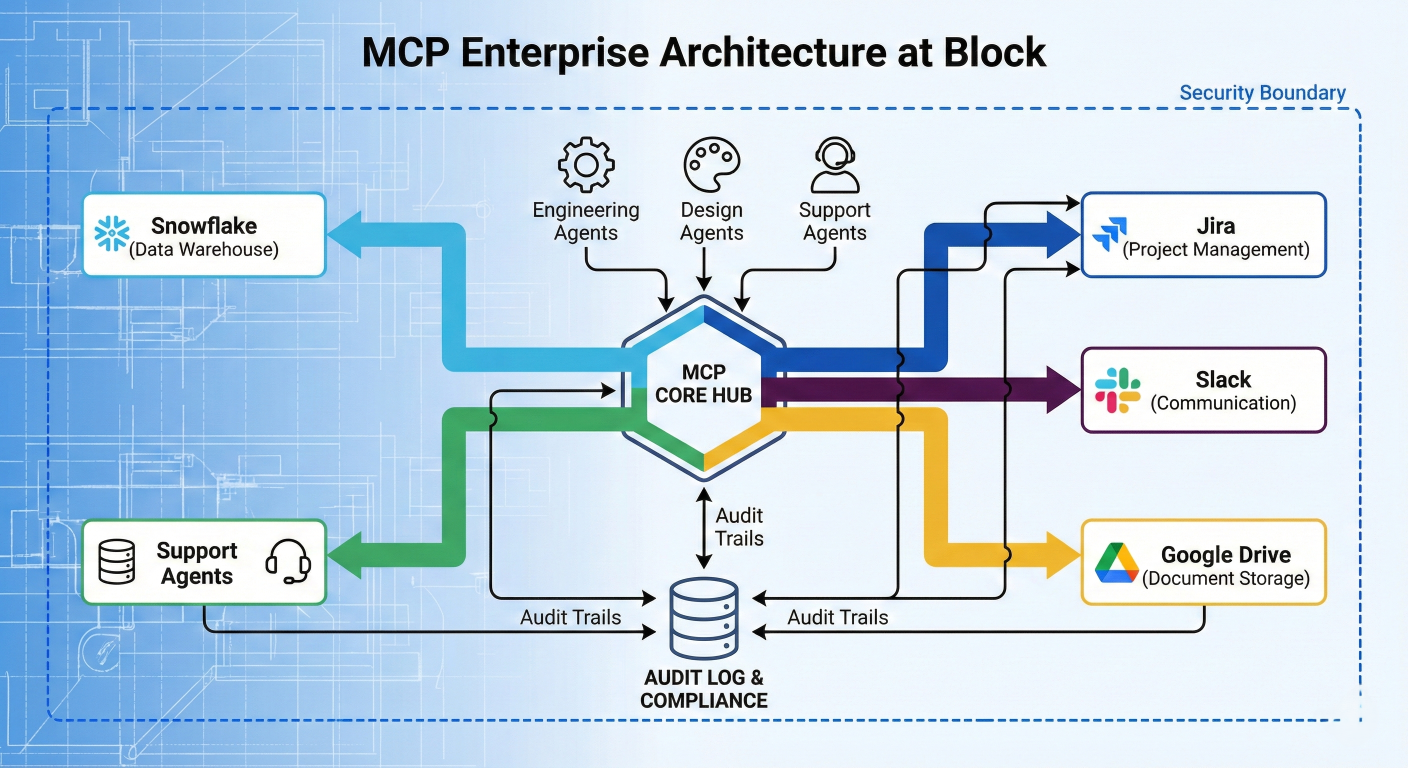
MCP Enterprise Architecture at Block: Show centralized MCP hub connecting to Snowflake, Jira, Slack, Google Drive; multiple agent types (engineering, design, data, support) accessing different tool combinations; include security boundaries and audit trails
The Model Control Plane operates on several fundamental principles that distinguish it from traditional model serving architectures. These principles guide design decisions and implementation strategies for scalable AI systems.
Separation of Control and Data Planes: The control plane makes decisions about routing, policies, and lifecycle management without directly handling inference requests. This separation enables independent scaling, policy enforcement, and governance without impacting inference performance. The data plane focuses solely on executing inference requests efficiently.
Policy-Driven Operations: All decisions about model selection, access control, and resource allocation are driven by explicitly defined policies rather than hard-coded logic. This enables non-technical stakeholders to modify behavior without code changes and ensures consistent enforcement across all interactions.
Multi-Tenancy by Design: The architecture supports multiple teams, projects, and environments with appropriate isolation and resource sharing. Each tenant can have different policies, budgets, and access controls while sharing underlying infrastructure efficiently.
Observability as a First-Class Citizen: Comprehensive monitoring, logging, and analytics are built into every component rather than added as an afterthought. This enables proactive optimization, debugging, and compliance reporting.
Vendor Neutrality: The control plane abstracts away differences between model providers, enabling seamless migration between vendors and multi-cloud deployments without application changes
Model Registry and Metadata Management
The model registry serves as the single source oftraining datasets, evaluation metrics, approval status, and deployment history. truth for all models, versions, and their metadata. Unlike simple model stores, an enterprise registry maintains rich metadata including.
Key capabilities include:
# Example model registry entry
models:
  - id: "gpt-4-turbo-2024-04-09"
    name: "GPT-4 Turbo April 2024"
    provider: "openai"
    capabilities:
      - "text-generation"
      - "code-completion"
      - "reasoning"
    performance:
      max_tokens: 128000
      latency_p95_ms: 2800
      throughput_req_per_min: 500
    cost:
      input_token_price_per_1k: 0.01
      output_token_price_per_1k: 0.03
    compliance:
      data_residency: ["us", "eu"]
      certifications: ["soc2", "iso27001"]
    deployment:
      endpoints:
        - region: "us-east-1"
          url: "https://api.openai.com/v1/chat/completions"
          auth_type: "bearer_token"
        - region: "eu-west-1"
          url: "https://api.openai.com/v1/chat/completions"
          auth_type: "bearer_token"
Policy Engine and Governance Framework
The policy engine enforces organizational rules and compliance requirements across all AI interactions. Modern implementations support both role-based access control (RBAC) and attribute-based access control (ABAC) for fine-grained permissions.
Policy categories include:
# Example policy configuration
policies:
  access_control:
    - name: "pii-sensitive-routing"
      conditions:
        - data_classification: "pii"
        - user_role: ["data-scientist", "analyst"]
      actions:
        - route_to: "privacy-compliant-models"
        - enable_logging: true
        - require_approval: true

  cost_management:
    - name: "development-budget-limits"
      conditions:
        - environment: "dev"
        - project: "*"
      actions:
        - monthly_budget_usd: 1000
        - daily_budget_usd: 50
        - alert_threshold: 0.8
        - throttle_at_limit: true

  quality_assurance:
    - name: "production-quality-gates"
      conditions:
        - environment: "prod"
        - model_type: "text-generation"
      actions:
        - min_quality_score: 0.85
        - require_human_review: false
        - shadow_traffic_percent: 10
The routing layer makes real-time decisions about which model endpoints should handle each request based on multiple factors including performance requirements, cost constraints, and availability
Advanced routing strategies include:
# Example routing logic implementation
class IntelligentRouter:
    def __init__(self, policy_engine, model_registry, metrics_collector):
        self.policy_engine = policy_engine
        self.model_registry = model_registry
        self.metrics = metrics_collector

    def route_request(self, request, user_context):
        # Apply policy filters
        eligible_models = self.policy_engine.filter_models(
            request.domain,
            user_context.permissions,
            request.data_classification
        )

        # Score models by cost-performance
        scored_models = []
        for model in eligible_models:
            performance_score = self.calculate_performance_score(
                model, request.complexity
            )
            cost_score = self.calculate_cost_score(
                model, request.estimated_tokens
            )
            availability_score = self.metrics.get_availability(model.id)

            total_score = (
                performance_score * 0.4 +
                cost_score * 0.3 +
                availability_score * 0.3
            )
            scored_models.append((model, total_score))

        # Select best model with fallback options
        scored_models.sort(key=lambda x: x[1], reverse=True)
        primary_model = scored_models[0][0]
        fallback_models = [m[0] for m in scored_models[1:3]]

        return RoutingDecision(
            primary=primary_model,
            fallbacks=fallback_models,
            routing_reason="cost_performance_optimized"
        )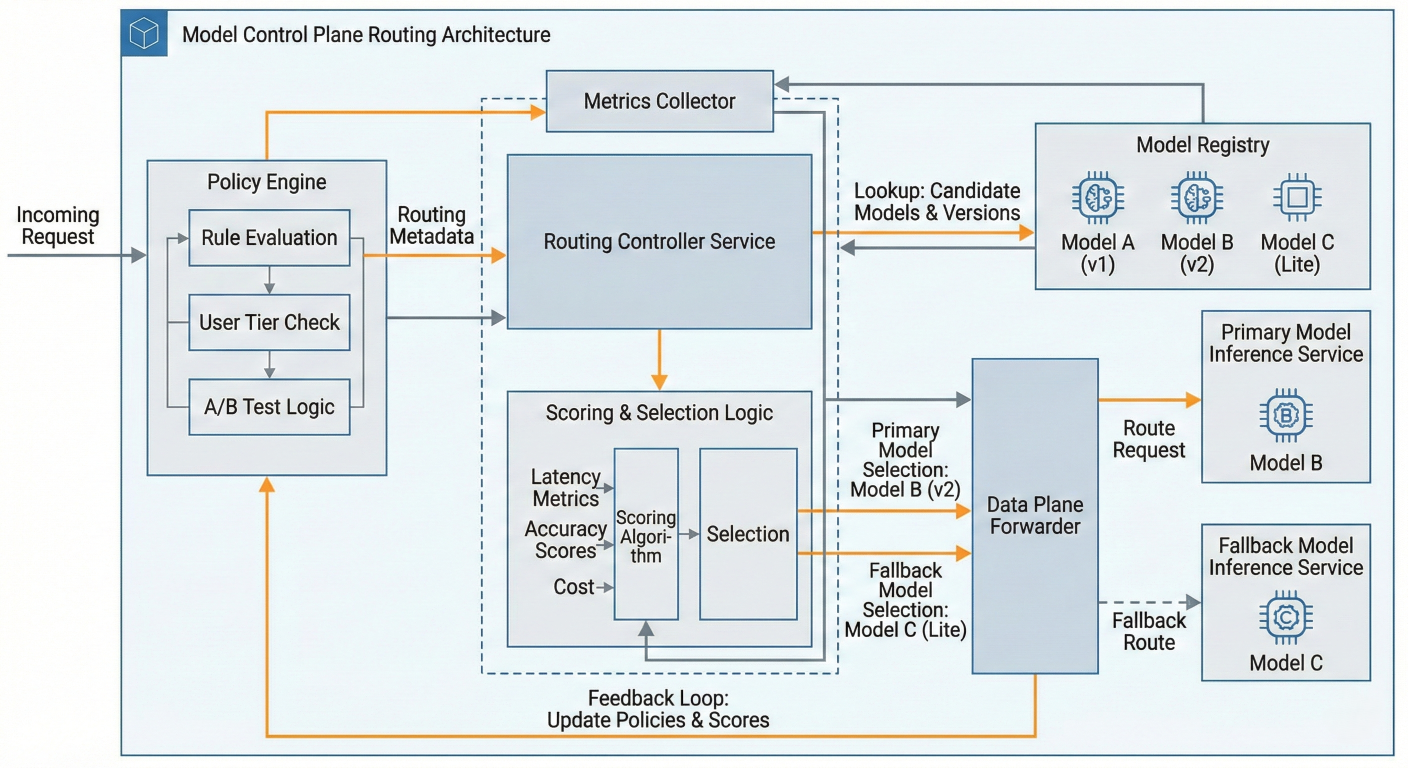
Model Control Plane Routing Architecture: Show request flow through policy engine, model registry lookup, scoring algorithm, primary/fallback selection, and metrics collection loop
Enterprise observability goes beyond basic metrics to provide actionable insights for optimization and compliance. The system must track performance, costs, quality, and business impact across all AI interactions.
Key observability components:
# Example observability implementation
from dataclasses import dataclass
from typing import Dict, Optional
import time


@dataclass
class RequestMetrics:
    request_id: str
    user_id: str
    model_id: str
    start_time: float
    end_time: Optional[float] = None
    input_tokens: int = 0
    output_tokens: int = 0
    cost_usd: float = 0.0
    quality_score: Optional[float] = None
    business_outcome: Optional[str] = None


class ObservabilityCollector:
    def __init__(self, metrics_backend, cost_tracker, quality_evaluator):
        self.metrics = metrics_backend
        self.costs = cost_tracker
        self.quality = quality_evaluator

    def track_request(self, request_id: str, user_context, model_selection):
        return RequestMetrics(
            request_id=request_id,
            user_id=user_context.user_id,
            model_id=model_selection.model_id,
            start_time=time.time()
        )

    def record_completion(self, metrics: RequestMetrics, response):
        metrics.end_time = time.time()
        metrics.input_tokens = response.usage.prompt_tokens
        metrics.output_tokens = response.usage.completion_tokens
        metrics.cost_usd = self.costs.calculate_cost(
            metrics.model_id,
            metrics.input_tokens,
            metrics.output_tokens
        )

        # Asynchronous quality evaluation
        self.quality.evaluate_async(
            metrics.request_id,
            response.content,
            callback=lambda score: self.update_quality_score(
                metrics.request_id, score
            )
        )

        # Store comprehensive metrics
        self.metrics.record({
            'request_id': metrics.request_id,
            'latency_ms': (metrics.end_time - metrics.start_time) * 1000,
            'cost_usd': metrics.cost_usd,
            'token_count': metrics.input_tokens + metrics.output_tokens,
            'model_id': metrics.model_id,
            'user_id': metrics.user_id,
            'timestamp': metrics.end_time
        })
Cost optimization in AI systems requires sophisticated strategies that balance performance, quality, and financial constraints. The control plane enables automated cost management that adapts to changing usage patterns and business requirements.
Dynamic Model Selection Based on Cost-Performance Profiles
Different models have varying cost-performance characteristics that change based on task complexity, input length, and quality requirements. The control plane maintains detailed costperformance models and automatically selects optimal configurations.
class CostOptimizer:
    def __init__(self, model_registry, performance_predictor):
        self.models = model_registry
        self.predictor = performance_predictor

    def optimize_selection(self, request, quality_threshold=0.8, budget_limit=None):
        candidates = []

        for model in self.models.get_eligible_models(request):
            # Predict performance and cost
            predicted_quality = self.predictor.predict_quality(
                model.id, request.complexity, request.domain
            )
            estimated_cost = self.predictor.estimate_cost(
                model.id, request.estimated_tokens
            )

            if predicted_quality >= quality_threshold:
                efficiency_score = predicted_quality / estimated_cost
                candidates.append({
                    'model': model,
                    'quality': predicted_quality,
                    'cost': estimated_cost,
                    'efficiency': efficiency_score
                })

        # Apply budget constraints
        if budget_limit:
            candidates = [c for c in candidates if c['cost'] <= budget_limit]

        # Select most efficient model
        if candidates:
            optimal = max(candidates, key=lambda x: x['efficiency'])
            return ModelSelection(
                model=optimal['model'],
                predicted_quality=optimal['quality'],
                estimated_cost=optimal['cost'],
                selection_reason="cost_efficiency_optimized"
            )

        return None  # No suitable model found
Intelligent Caching and Result Reuse
Caching strategies can significantly reduce costs by avoiding redundant computations. The control plane implements multi-level caching with semantic similarity matching for language model outputs
import hashlib
from typing import Optional, Tuple

class SemanticCache:
    def __init__(self, vector_store, similarity_threshold=0.85):
        self.vector_store = vector_store
        self.similarity_threshold = similarity_threshold
        self.exact_cache = {}  # Hash-based exact matching

    def get_cached_response(self, prompt: str, model_id: str) -> Optional[str]:
        # Try exact match first (fastest)
        exact_key = self._hash_key(prompt, model_id)
        if exact_key in self.exact_cache:
            return self.exact_cache[exact_key]

        # Try semantic similarity (slower but more flexible)
        similar_results = self.vector_store.similarity_search(
            prompt, model_filter=model_id, top_k=1
        )

        if similar_results and similar_results[0].similarity > self.similarity_threshold:
            cached_response = similar_results[0].response
            # Store in exact cache for future lookups
            self.exact_cache[exact_key] = cached_response
            return cached_response

        return None

    def store_response(
        self,
        prompt: str,
        model_id: str,
        response: str,
        cost: float
    ):
        exact_key = self._hash_key(prompt, model_id)
        self.exact_cache[exact_key] = response

        # Store in vector database for semantic matching
        self.vector_store.add_document({
            'prompt': prompt,
            'response': response,
            'model_id': model_id,
            'cost_saved': cost,
            'created_at': time.time()
        })

    def _hash_key(self, prompt: str, model_id: str) -> str:
        return hashlib.sha256(f"{prompt}:{model_id}".encode()).hexdigest()
Automated Budget Management and Alerts
The control plane enforces budget limits at multiple levels (organization, team, project, user) with sophisticated alerting and throttling mechanisms.
class BudgetManager:
    def __init__(self, budget_store, notification_service):
        self.budgets = budget_store
        self.notifications = notification_service

    def check_budget_constraints(
        self,
        user_context,
        estimated_cost: float
    ) -> Tuple[bool, Optional[str]]:
        # Check hierarchical budgets (user -> project -> team -> org)
        budget_levels = [
            ('user', user_context.user_id),
            ('project', user_context.project_id),
            ('team', user_context.team_id),
            ('organization', user_context.org_id)
        ]

        for level_type, level_id in budget_levels:
            budget = self.budgets.get_budget(level_type, level_id)
            if not budget:
                continue

            current_spend = self.budgets.get_current_spend(level_type, level_id)
            projected_spend = current_spend + estimated_cost

            # Hard limit check
            if projected_spend > budget.limit:
                return False, f"{level_type} budget exceeded"

            # Alert threshold check
            utilization = projected_spend / budget.limit
            if utilization >= budget.alert_threshold:
                self.notifications.send_budget_alert(
                    level_type, level_id, utilization, budget.limit
                )

        return True, None

    def record_spend(self, user_context, actual_cost: float):
        # Record spend at all applicable levels
        budget_levels = [
            ('user', user_context.user_id),
            ('project', user_context.project_id),
            ('team', user_context.team_id),
            ('organization', user_context.org_id)
        ]

        for level_type, level_id in budget_levels:
            self.budgets.increment_spend(level_type, level_id, actual_cost)

Budget Management Dashboard: Show hierarchical budget visualization (org -> team -> project -> user), real-time spend tracking, alert thresholds, cost projection graphs, and top spending models/users
The Model Context Protocol establishes a standardized framework for AI applications to interact with external tools and data sources. Built on JSON-RPC 2.0, MCP defines clear contracts for capability discovery, authentication, and tool invocation that work consistently across different AI platforms and tool providers.
Client-Server Architecture: MCP follows a clean client-server model where AI applications (hosts) embed MCP clients that connect to MCP servers exposing specific capabilities. Each client maintains a dedicated connection to one server, ensuring clear security boundaries and simplified debugging.
Capability Discovery: Servers dynamically expose their available tools, resources, and prompts through standardized discovery mechanisms. This allows AI applications to adapt their behavior based on available capabilities without requiring hardcoded integrations.
Transport Layer Flexibility: MCP supports multiple transport mechanisms including STDIO for local integrations and HTTP with Server-Sent Events for remote connections. This flexibility enables deployment patterns ranging from local development to distributed cloud architectures.
Schema-Driven Validation: All tool interfaces are defined using JSON schemas that enforce input validation and output formatting. This prevents malformed requests and ensures predictable behavior across different implementations
Tools: Model-Controlled Executable Functions
Tools represent actions that AI models can invoke to interact with external systems. Each tool has a unique name, description, and parameter schema that guide the model's decision-making process.
// Example MCP server exposing database tools
import { FastMCP } from 'fastmcp';

const server = new FastMCP('database-server');

server.addTool({
  name: 'query_customer_data',
  description: 'Retrieve customer information by ID or email',
  parameters: {
    type: 'object',
    properties: {
      customer_id: {
        type: 'string',
        description: 'Unique customer identifier'
      },
      email: {
        type: 'string',
        format: 'email',
        description: 'Customer email address'
      },
      include_orders: {
        type: 'boolean',
        default: false,
        description: 'Include recent order history'
      }
    },
    oneOf: [
      { required: ['customer_id'] },
      { required: ['email'] }
    ]
  }
}, async (params) => {
  // Input validation handled by schema
  const customer = await database.customers.findUnique({
    where: params.customer_id ?
      { id: params.customer_id } :
      { email: params.email },
    include: {
      orders: params.include_orders ? {
        take: 10,
        orderBy: { createdAt: 'desc' }
      } : false
    }
  });

  if (!customer) {
    throw new Error('Customer not found');
  }

  return {
    customer: {
      id: customer.id,
      name: customer.name,
      email: customer.email,
      status: customer.status,
      orders: customer.orders || []
    }
  };
});

server.addTool({
  name: 'create_support_ticket',
  description: 'Create a new customer support ticket',
  parameters: {
    type: 'object',
    properties: {
      customer_id: { type: 'string' },
      subject: { type: 'string', maxLength: 200 },
      description: { type: 'string', maxLength: 2000 },
      priority: {
        type: 'string',
        enum: ['low', 'medium', 'high', 'urgent'],
        default: 'medium'
      },
      category: {
        type: 'string',
        enum: ['billing', 'technical', 'account', 'general']
      }
    },
    required: ['customer_id', 'subject', 'description', 'category']
  }
}, async (params) => {
  const ticket = await database.supportTickets.create({
    data: {
      customerId: params.customer_id,
      subject: params.subject,
      description: params.description,
      priority: params.priority,
      category: params.category,
      status: 'open',
      createdBy: 'ai-agent'
    }
  });

  // Send notification to support team
  await notificationService.notifyNewTicket(ticket);

  return {
    ticket_id: ticket.id,
    status: 'created',
    estimated_response_time: '2-4 hours'
  };
});
Resources: Contextual Data Providers
Resources provide structured data that enriches the AI model's context without requiring explicit invocation. These are typically read-only data sources that the client application manages and injects into the model's context
// Example resource provider for documentation
server.addResource({
  uri: 'doc://api-reference',
  name: 'API Reference Documentation',
  description: 'Complete REST API documentation with examples'
}, async () => {
  const apiDocs = await documentationService.getApiReference();

  return {
    mimeType: 'text/markdown',
    content: apiDocs.content,
    metadata: {
      version: apiDocs.version,
      lastUpdated: apiDocs.lastUpdated,
      sections: apiDocs.sections
    }
  };
});

server.addResource({
  uri: 'schema://database',
  name: 'Database Schema',
  description: 'Current database schema with table relationships'
}, async () => {
  const schema = await database.introspectSchema();

  return {
    mimeType: 'application/json',
    content: JSON.stringify(schema, null, 2),
    metadata: {
      tables: schema.tables.length,
      relationships: schema.relationships.length,
      lastMigration: schema.lastMigration
    }
  };
});
Prompts: Interactive Templates
Prompts provide user-controlled templates that guide AI interactions. These are particularly useful for creating consistent experiences across different use cases and users.
// Add a new prompt to analyze customer behavior
server.addPrompt({
  name: 'customer-analysis',
  description: 'Analyze customer behavior and provide insights',
  parameters: {
    type: 'object',
    properties: {
      customer_id: { type: 'string' },
      analysis_period: {
        type: 'string',
        enum: ['7d', '30d', '90d', '1y'],
        default: '30d'
      },
      include_predictions: {
        type: 'boolean',
        default: true
      }
    },
    required: ['customer_id']
  }
}, async (params) => {
  const customer = await database.customers.findUnique({
    where: { id: params.customer_id },
    include: {
      orders: {
        where: {
          createdAt: {
            gte: getPeriodStartDate(params.analysis_period)
          }
        }
      },
      supportTickets: true,
      interactions: true
    }
  });

  return {
    role: 'user',
    content: `Analyze the following customer data and provide insights:

**Customer Profile:**
- Name: ${customer.name}
- Email: ${customer.email}
- Join Date: ${customer.createdAt}
- Status: ${customer.status}

**Recent Activity (${params.analysis_period}):**
- Orders: ${customer.orders.length}
- Total Spent: $${customer.orders.reduce((sum, order) => sum + order.total, 0)}
- Support Tickets: ${customer.supportTickets.length}
- Last Interaction: ${customer.interactions[0]?.createdAt || 'None'}

Please provide:
1. Customer health score (1-10)
2. Key behavioral patterns
3. Potential risks or opportunities
${params.include_predictions ? '4. Predictions for next 30 days' : ''}
5. Recommended actions`
  };
});
Production MCP servers require robust error handling, authentication, monitoring, and security controls. The following example demonstrates enterprise-ready patterns.
import { FastMCP } from 'fastmcp';
import { Logger } from 'winston';
import { RateLimiter } from 'bottleneck';
import { validateToken, checkPermissions } from './auth';
import { AuditLogger } from './audit';

class EnterpriseMCPServer {
  private server: FastMCP;
  private logger: Logger;
  private rateLimiter: RateLimiter;
  private auditLogger: AuditLogger;

  constructor(config: ServerConfig) {
    this.server = new FastMCP(config.name);
    this.logger = new Logger(config.logging);
    this.rateLimiter = new RateLimiter({
      minTime: config.rateLimit.minTimeMs,
      maxConcurrent: config.rateLimit.maxConcurrent
    });
    this.auditLogger = new AuditLogger(config.audit);

    this.setupMiddleware();
    this.setupErrorHandling();
  }

  private setupMiddleware() {
    // Authentication middleware
    this.server.use(async (context, next) => {
      try {
        const token = context.headers['authorization']?.replace('Bearer ', '');
        if (!token) {
          throw new Error('Authentication required');
        }

        const user = await validateToken(token);
        context.user = user;

        this.auditLogger.logAccess({
          userId: user.id,
          action: 'server_access',
          serverName: this.server.name,
          timestamp: new Date()
        });

        await next();
      } catch (error) {
        this.logger.error('Authentication failed', { error: error.message });
        throw new Error('Authentication failed');
      }
    });

    // Rate limiting middleware
    this.server.use(async (context, next) => {
      await this.rateLimiter.schedule(async () => {
        await next();
      });
    });

    // Request logging middleware
    this.server.use(async (context, next) => {
      const startTime = Date.now();

      try {
        await next();

        this.logger.info('Request completed', {
          userId: context.user?.id,
          method: context.method,
          duration: Date.now() - startTime,
          status: 'success'
        });
      } catch (error) {
        this.logger.error('Request failed', {
          userId: context.user?.id,
          method: context.method,
          duration: Date.now() - startTime,
          error: error.message,
          status: 'error'
        });
        throw error;
      }
    });
  }

  private setupErrorHandling() {
    this.server.onError((error, context) => {
      // Sanitize error messages for security
      const sanitizedError = this.sanitizeError(error);

      this.auditLogger.logError({
        userId: context.user?.id,
        error: error.message,
        stackTrace: error.stack,
        context: {
          method: context.method,
          params: context.params
        },
        timestamp: new Date()
      });

      return {
        error: {
          code: sanitizedError.code,
          message: sanitizedError.message
        }
      };
    });
  }

  addSecureTool(
    toolDefinition: ToolDefinition,
    handler: ToolHandler,
    requiredPermissions: string[]
  ) {
    this.server.addTool(toolDefinition, async (params, context) => {
      // Permission check
      const hasPermission = await checkPermissions(
        context.user,
        requiredPermissions
      );

      if (!hasPermission) {
        throw new Error('Insufficient permissions');
      }

      // Input validation and sanitization
      const sanitizedParams = this.sanitizeInput(params, toolDefinition.parameters);

      // Audit log tool invocation
      this.auditLogger.logToolInvocation({
        userId: context.user.id,
        toolName: toolDefinition.name,
        parameters: sanitizedParams,
        timestamp: new Date()
      });

      try {
        const result = await handler(sanitizedParams, context);

        // Audit log successful completion
        this.auditLogger.logToolCompletion({
          userId: context.user.id,
          toolName: toolDefinition.name,
          success: true,
          timestamp: new Date()
        });

        return result;
      } catch (error) {
        // Audit log failure
        this.auditLogger.logToolCompletion({
          userId: context.user.id,
          toolName: toolDefinition.name,
          success: false,
          error: error.message,
          timestamp: new Date()
        });

        throw error;
      }
    });
  }

  private sanitizeInput(input: any, schema: JSONSchema): any {
    // Implement input sanitization based on schema
    // Remove potentially dangerous content
    // Validate against schema constraints
    return input; // Simplified for example
  }

  private sanitizeError(error: Error): { code: string, message: string } {
    // Prevent information leakage in error messages
    if (error.message.includes('database') || error.message.includes('sql')) {
      return { code: 'DATABASE_ERROR', message: 'A database error occurred' };
    }

    if (error.message.includes('authentication') || error.message.includes('token')) {
      return { code: 'AUTH_ERROR', message: 'Authentication failed' };
    }

    return { code: 'GENERAL_ERROR', message: 'An error occurred' };
  }
}
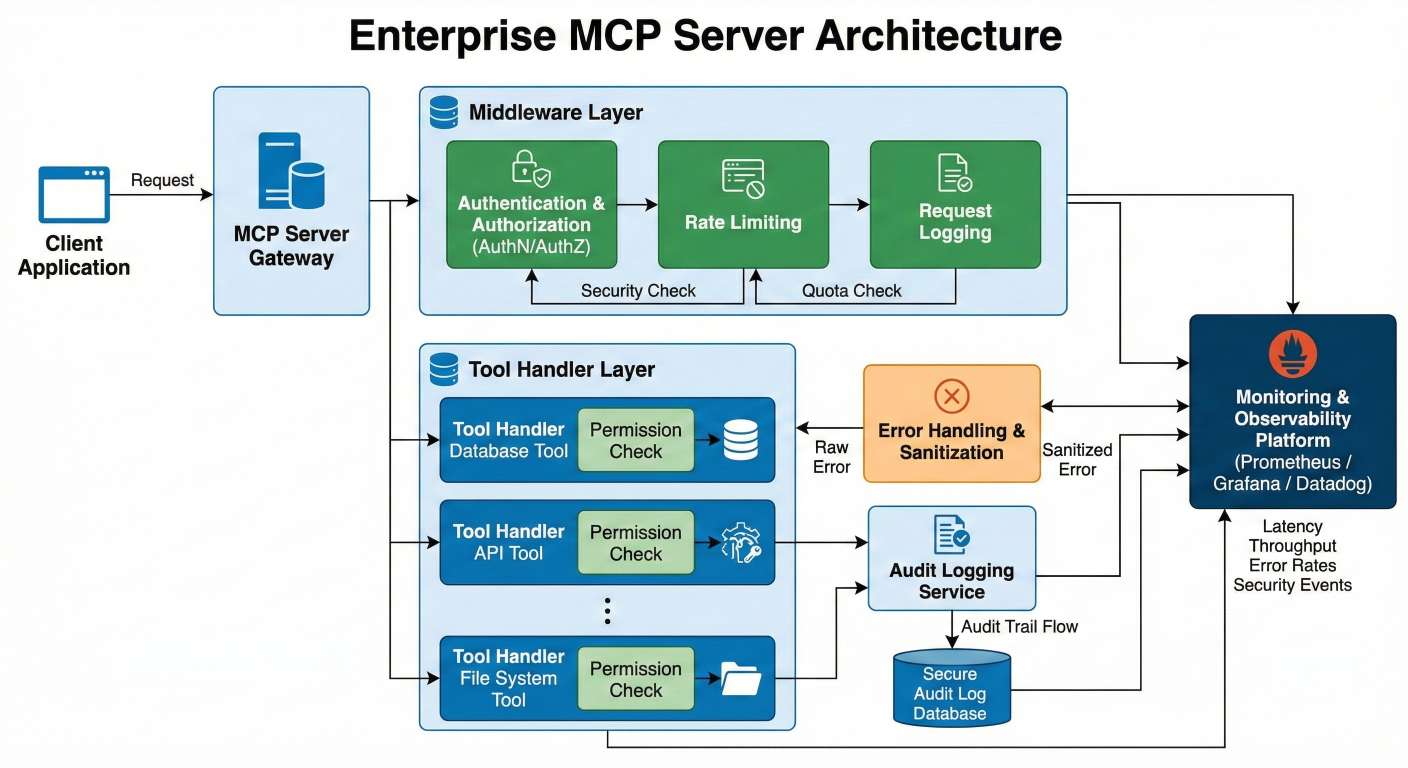
Enterprise MCP Server Architecture: Show middleware layers (auth, rate limiting, logging), tool handlers with permission checks, audit logging flow, error sanitization, and monitoring integration
Security in MCP deployments requires defense-in-depth strategies that protect against various attack vectors including prompt injection, credential compromise, and unauthorized access.
Authentication and Authorization
// Enterprise authentication implementation
class MCPAuthManager {
  private tokenValidator: JWTValidator;
  private permissionEngine: PermissionEngine;
  private auditLogger: AuditLogger;

  constructor(config: AuthConfig) {
    this.tokenValidator = new JWTValidator({
      issuer: config.oidc.issuer,
      audience: config.oidc.audience,
      algorithms: ['RS256'],
      cache: true,
      cacheTTL: 300 // 5 minutes
    });

    this.permissionEngine = new PermissionEngine(config.rbac);
    this.auditLogger = new AuditLogger(config.audit);
  }

  async authenticateRequest(authHeader: string): Promise<AuthContext> {
    if (!authHeader?.startsWith('Bearer ')) {
      throw new AuthError('Invalid authorization header');
    }

    const token = authHeader.substring(7);

    try {
      // Validate JWT token
      const payload = await this.tokenValidator.verify(token);

      // Create auth context
      const authContext = new AuthContext({
        userId: payload.sub,
        email: payload.email,
        roles: payload.roles || [],
        permissions: payload.permissions || [],
        organizationId: payload.org_id,
        tokenId: payload.jti
      });

      // Log successful authentication
      this.auditLogger.logAuth({
        userId: authContext.userId,
        action: 'authenticate',
        success: true,
        timestamp: new Date()
      });

      return authContext;
    } catch (error) {
      // Log failed authentication
      this.auditLogger.logAuth({
        token: token.substring(0, 10) + '...',
        action: 'authenticate',
        success: false,
        error: error.message,
        timestamp: new Date()
      });

      throw new AuthError('Token validation failed');
    }
  }

  async checkToolPermission(
    authContext: AuthContext,
    toolName: string,
    parameters: any
  ): Promise<boolean> {
    // Check basic tool access
    const hasToolAccess = await this.permissionEngine.hasPermission(
      authContext,
      `tool:${toolName}:execute`
    );

    if (!hasToolAccess) {
      return false;
    }

    // Check parameter-level permissions
    const paramPermissions = await this.permissionEngine.checkParameterAccess(
      authContext,
      toolName,
      parameters
    );

    // Log permission check
    this.auditLogger.logPermissionCheck({
      userId: authContext.userId,
      resource: `tool:${toolName}`,
      action: 'execute',
      granted: hasToolAccess && paramPermissions.allowed,
      restrictions: paramPermissions.restrictions,
      timestamp: new Date()
    });

    return hasToolAccess && paramPermissions.allowed;
  }
}

// Permission engine with RBAC and ABAC support
class PermissionEngine {
  private policies: PolicyStore;
  private attributeProvider: AttributeProvider;

  async hasPermission(
    authContext: AuthContext,
    permission: string
  ): Promise<boolean> {
    // Check role-based permissions
    const rolePermissions = await this.getRolePermissions(authContext.roles);
    if (rolePermissions.includes(permission)) {
      return true;
    }

    // Check attribute-based permissions
    const attributes = await this.attributeProvider.getAttributes(authContext);
    const abacResult = await this.evaluateABACPolicies(
      authContext,
      permission,
      attributes
    );

    return abacResult.allowed;
  }

  async checkParameterAccess(
    authContext: AuthContext,
    toolName: string,
    parameters: any
  ): Promise<{ allowed: boolean, restrictions: string[] }> {
    const restrictions = [];

    // Check data classification restrictions
    if (parameters.data_classification) {
      const canAccessClassification = await this.hasPermission(
        authContext,
        `data:${parameters.data_classification}:read`
      );

      if (!canAccessClassification) {
        return { allowed: false, restrictions: ['data_classification'] };
      }
    }

    // Check customer data access
    if (parameters.customer_id) {
      const canAccessCustomer = await this.checkCustomerAccess(
        authContext,
        parameters.customer_id
      );

      if (!canAccessCustomer) {
        restrictions.push('customer_access');
      }
    }

    return {
      allowed: restrictions.length === 0,
      restrictions
    };
  }
}
Input Validation and Sanitization
class InputValidator {
  private schemaValidator: JSONSchemaValidator;
  private sanitizer: InputSanitizer;

  constructor() {
    this.schemaValidator = new JSONSchemaValidator();
    this.sanitizer = new InputSanitizer({
      // Remove potentially dangerous patterns
      patterns: [
        /system\s*:/gi,           // System prompt injection
        /ignore\s+previous/gi,    // Instruction override
        /forget\s+everything/gi,  // Context reset attempts
        /<script\b[^<]*(?:(?!<\/script>)<[^<]*)*<\/script>/gi, // XSS
        /sql\s*injection/gi,      // SQL injection keywords
        /eval\s*\(/gi,             // Code execution
        /exec\s*\(/gi              // Command execution
      ],
      maxLength: {
        string: 10000,
        array: 1000,
        object: 100
      }
    });
  }

  validateAndSanitize(input: any, schema: JSONSchema): ValidationResult {
    // Schema validation
    const schemaResult = this.schemaValidator.validate(input, schema);
    if (!schemaResult.valid) {
      return {
        valid: false,
        errors: schemaResult.errors,
        sanitized: null
      };
    }

    // Input sanitization
    const sanitized = this.sanitizer.sanitize(input);

    // Additional security checks
    const securityResult = this.performSecurityChecks(sanitized);
    if (!securityResult.safe) {
      return {
        valid: false,
        errors: ['Input contains potentially dangerous content'],
        sanitized: null,
        securityIssues: securityResult.issues
      };
    }

    return {
      valid: true,
      errors: [],
      sanitized: sanitized,
      securityIssues: []
    };
  }

  private performSecurityChecks(input: any): SecurityCheckResult {
    const issues = [];

    // Check for prompt injection patterns
    const stringifiedInput = JSON.stringify(input).toLowerCase();

    if (stringifiedInput.includes('ignore previous')) {
      issues.push('potential_prompt_injection');
    }

    if (stringifiedInput.includes('system:') || stringifiedInput.includes('assistant:')) {
      issues.push('role_confusion_attempt');
    }

    // Check for excessive nesting (potential DoS)
    const maxDepth = this.calculateObjectDepth(input);
    if (maxDepth > 10) {
      issues.push('excessive_nesting');
    }

    return {
      safe: issues.length === 0,
      issues: issues
    };
  }
}
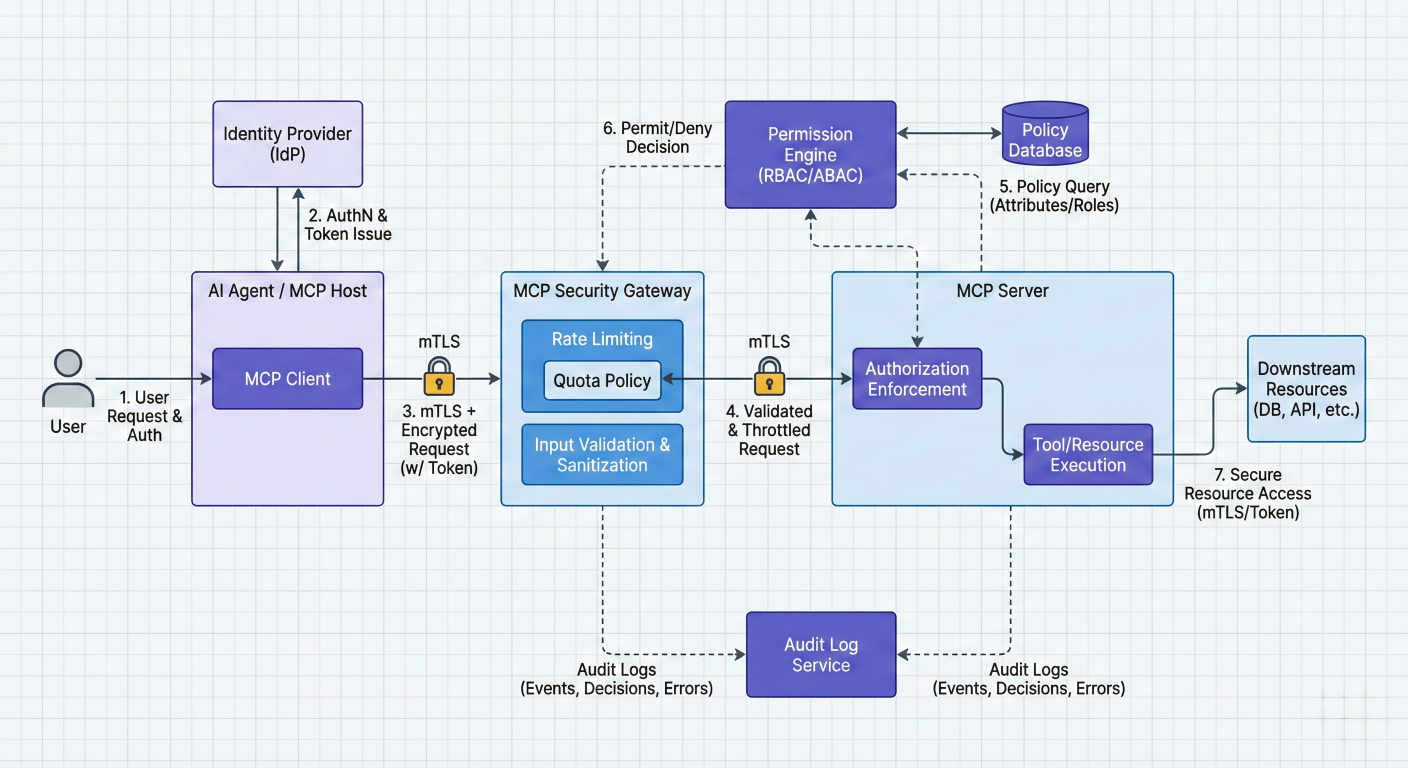
MCP Security Architecture: Show authentication flow, permission engine (RBAC/ABAC), input validation/sanitization, audit logging, rate limiting, and transport security (mTLS)
Traditional RAG systems retrieve static documents from vector databases. MCP extends this pattern by enabling dynamic tool invocation that can fetch real-time data, perform calculations, and interact with live systems during the retrieval process.
Dynamic Context Augmentation
import asyncio
from typing import List, Dict, Any, Optional
from dataclasses import dataclass
from mcp_client import MCPClient
from vector_store import VectorStore
from llm_client import LLMClient

@dataclass
class EnhancedContext:
    static_documents: List[str]
    dynamic_data: Dict[str, Any]
    tool_outputs: List[Dict[str, Any]]
    metadata: Dict[str, Any]

class MCPEnhancedRAG:
    def __init__(self, vector_store: VectorStore, llm_client: LLMClient, mcp_clients: Dict[str, MCPClient]):
        self.vector_store = vector_store
        self.llm = llm_client
        self.mcp_clients = mcp_clients

    async def enhanced_retrieval(self, query: str, user_context: Dict[str, Any]) -> EnhancedContext:
        # Traditional vector-based retrieval
        static_docs = await self.vector_store.similarity_search(query, k=5, filters={'user_id': user_context.get('user_id')})

        # Dynamic data retrieval through MCP
        dynamic_data = {}
        tool_outputs = []

        # Customer context retrieval
        if 'customer_id' in user_context:
            customer_client = self.mcp_clients['customer_db']
            customer_data = await customer_client.call_tool('get_customer_profile', {'customer_id': user_context['customer_id']})
            dynamic_data['customer'] = customer_data
            tool_outputs.append({'tool': 'get_customer_profile', 'output': customer_data})

        # Real-time system status
        if self.requires_system_status(query):
            system_client = self.mcp_clients['monitoring']
            system_status = await system_client.call_tool('get_system_health', {'components': ['api', 'database', 'cache']})
            dynamic_data['system_status'] = system_status
            tool_outputs.append({'tool': 'get_system_health', 'output': system_status})

        # Market data for financial queries
        if self.is_financial_query(query):
            market_client = self.mcp_clients['market_data']
            market_data = await market_client.call_tool('get_market_snapshot', {'symbols': self.extract_symbols(query)})
            dynamic_data['market_data'] = market_data
            tool_outputs.append({'tool': 'get_market_snapshot', 'output': market_data})

        return EnhancedContext(
            static_documents=[doc.content for doc in static_docs],
            dynamic_data=dynamic_data,
            tool_outputs=tool_outputs,
            metadata={'query': query, 'retrieval_timestamp': asyncio.get_event_loop().time(), 'tools_used': [output['tool'] for output in tool_outputs]}
        )

    async def generate_response(self, query: str, context: EnhancedContext) -> Dict[str, Any]:
        # Construct comprehensive prompt
        prompt = self.build_enhanced_prompt(query, context)

        # Generate response with full context
        response = await self.llm.generate(prompt, max_tokens=2000, temperature=0.1)

        return {'response': response.text, 'sources': {'static_documents': len(context.static_documents), 'dynamic_sources': list(context.dynamic_data.keys()), 'tools_invoked': [out['tool'] for out in context.tool_outputs]}, 'metadata': context.metadata, 'confidence': response.confidence_score}

    def build_enhanced_prompt(self, query: str, context: EnhancedContext) -> str:
        prompt_parts = [f"User Query: {query}", "", "Static Knowledge Base:"]
        # Add static documents
        for i, doc in enumerate(context.static_documents, 1):
            prompt_parts.append(f"Document {i}: {doc[:500]}...")
        # Add dynamic data
        if context.dynamic_data:
            prompt_parts.extend(["", "Real-time Context:"])
            for source, data in context.dynamic_data.items():
                prompt_parts.append(f"{source.title()}: {self.format_data(data)}")
        # Add tool outputs with explanations
        if context.tool_outputs:
            prompt_parts.extend(["", "Live System Data:"])
            for tool_output in context.tool_outputs:
                tool_name = tool_output['tool']
                output = tool_output['output']
                prompt_parts.append(f"From {tool_name}: {self.format_data(output)}")
        prompt_parts.extend(["", "Instructions:", "1. Use ALL available context (static, dynamic, and live data)", "2. Prioritize real-time information over static documents when conflicts exist", "3. Cite specific sources for factual claims", "4. If data is incomplete, clearly state limitations", "5. Provide actionable recommendations when appropriate", "", "Response:"])
        return "\n".join(prompt_parts)

    def format_data(self, data: Any) -> str:
        """Format complex data structures for prompt inclusion"""
        if isinstance(data, dict):
            return "; ".join([f"{k}: {v}" for k, v in data.items()])
        elif isinstance(data, list):
            return "; ".join([str(item) for item in data[:5]])
        else:
            return str(data)[:200]
class FinancialAdvisoryRAG(MCPEnhancedRAG):
    async def analyze_portfolio(
        self,
        user_query: str,
        portfolio_id: str
    ) -> Dict[str, Any]:
        # Enhanced retrieval with financial context
        context = await self.enhanced_retrieval(
            user_query,
            {'portfolio_id': portfolio_id}
        )

        # Get additional financial data through MCP
        portfolio_client = self.mcp_clients['portfolio_service']

        # Current holdings
        holdings = await portfolio_client.call_tool(
            'get_portfolio_holdings',
            {'portfolio_id': portfolio_id}
        )

        # Performance metrics
        performance = await portfolio_client.call_tool(
            'calculate_portfolio_metrics',
            {
                'portfolio_id': portfolio_id,
                'period': '1Y',
                'benchmarks': ['SPY', 'QQQ']
            }
        )

        # Risk analysis
        risk_analysis = await portfolio_client.call_tool(
            'analyze_portfolio_risk',
            {
                'portfolio_id': portfolio_id,
                'risk_factors': ['market', 'sector', 'geographic', 'currency']
            }
        )

        # Market conditions
        market_client = self.mcp_clients['market_data']
        market_conditions = await market_client.call_tool(
            'get_market_sentiment',
            {'indicators': ['vix', 'yield_curve', 'sector_rotation']}
        )

        # Enhance context with financial data
        context.dynamic_data.update({
            'holdings': holdings,
            'performance': performance,
            'risk_analysis': risk_analysis,
            'market_conditions': market_conditions
        })

        # Generate comprehensive analysis
        analysis = await self.generate_response(user_query, context)

        return {
            'analysis': analysis['response'],
            'data_sources': analysis['sources'],
            'recommendations': self.extract_recommendations(analysis['response']),
            'risk_score': risk_analysis.get('overall_risk_score'),
            'confidence': analysis['confidence']
} 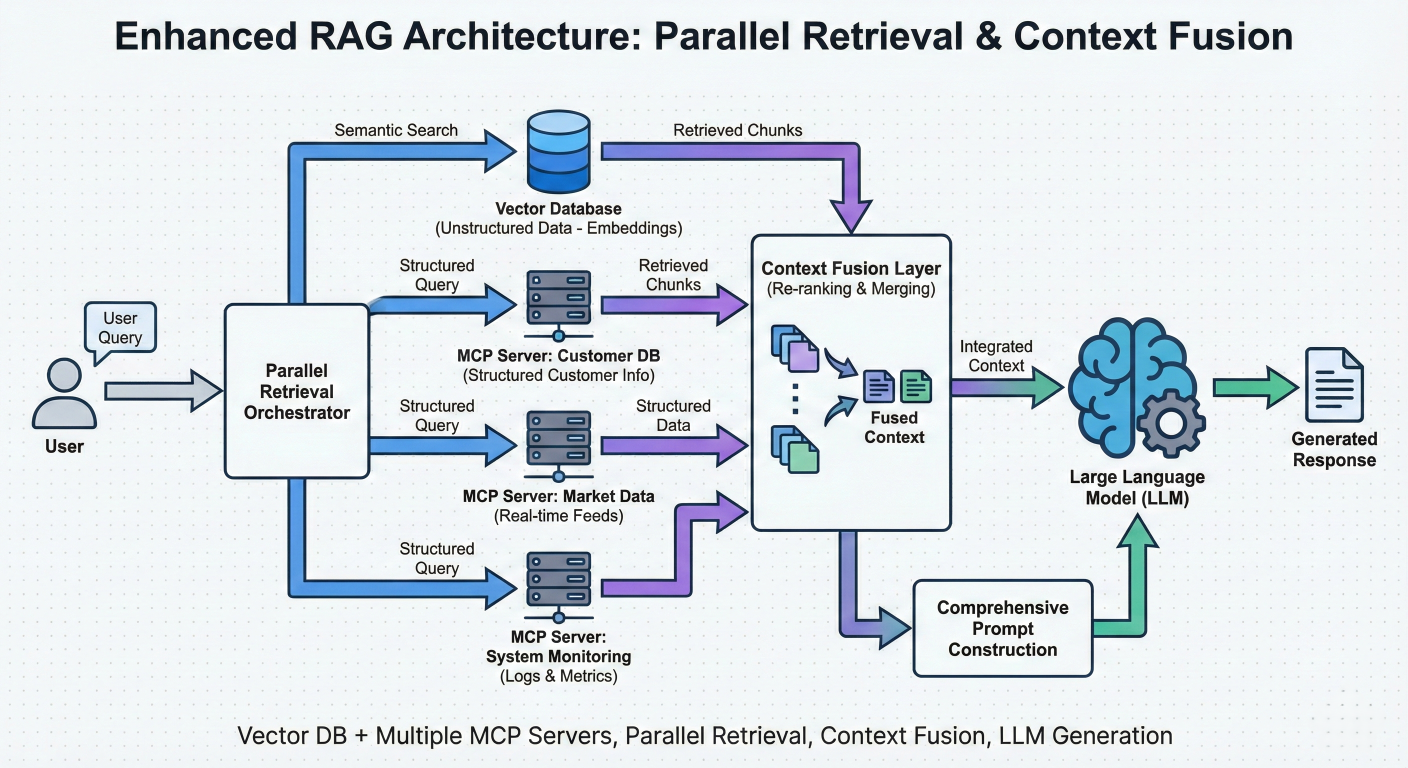
Enhanced RAG Architecture: Show vector database + multiple MCP servers (customer DB, market data, system monitoring), parallel retrieval, context fusion, and LLM generation with comprehensive prompt
Complex AI applications benefit from specialized agents coordinating through standardized MCP interfaces. This pattern enables scalable, maintainable multi-agent systems where each agent focuses on specific capabilities.
Agent Coordination Framework
from abc import ABC, abstractmethod
from enum import Enum
import asyncio
from typing import List, Dict, Any, Optional, Callable
import uuid
class AgentRole(Enum):
COORDINATOR = "coordinator"
SPECIALIST = "specialist"
VALIDATOR = "validator"
MONITOR = "monitor"
class TaskStatus(Enum):
PENDING = "pending"
IN_PROGRESS = "in_progress"
COMPLETED = "completed"
FAILED = "failed"
REQUIRES_VALIDATION = "requires_validation"
# Task dataclass definition
@dataclass
class Task:
id: str
type: str
description: str
parameters: Dict[str, Any]
assigned_agent: Optional[str] = None
status: TaskStatus = TaskStatus.PENDING
result: Optional[Any] = None
error: Optional[str] = None
dependencies: List[str] = None
created_at: float = None
completed_at: Optional[float] = None
# Abstract MCP Agent base class
class MCPAgent(ABC):
def __init__(
self,
agent_id: str,
role: AgentRole,
capabilities: List[str],
mcp_clients: Dict[str, MCPClient]
):
self.agent_id = agent_id
self.role = role
self.capabilities = capabilities
self.mcp_clients = mcp_clients
self.task_queue = asyncio.Queue()
self.active_tasks = {}
@abstractmethod
async def process_task(self, task: Task) -> Task:
"""Process a single task and return updated task with results"""
pass
async def can_handle_task(self, task: Task) -> bool:
"""Check if this agent can handle the given task type"""
return task.type in self.capabilities
async def execute_mcp_tool(
self,
server_name: str,
tool_name: str,
parameters: Dict[str, Any]
) -> Any:
"""Execute MCP tool with error handling and logging"""
try:
client = self.mcp_clients[server_name]
result = await client.call_tool(tool_name, parameters)
return result
except Exception as e:
raise Exception(f"MCP tool execution failed: {tool_name} - {str(e)}")
# Coordinator Agent implementation
class CoordinatorAgent(MCPAgent):
def __init__(self, agent_id: str, mcp_clients: Dict[str, MCPClient]):
super().__init__(
agent_id,
AgentRole.COORDINATOR,
["task_planning", "agent_coordination", "result_synthesis"],
mcp_clients
)
self.specialist_agents = {}
self.task_graph = {}
async process_complex_request(
self,
request: str,
context: Dict[str, Any]
) -> Dict[str, Any]:
"""Break down complex request into tasks and coordinate execution"""
# Plan task decomposition
task_plan = await self.plan_tasks(request, context)
# Create task graph with dependencies
tasks = []
for task_spec in task_plan['tasks']:
task = Task(
id=str(uuid.uuid4()),
type=task_spec['type'],
description=task_spec['description'],
parameters=task_spec['parameters'],
dependencies=task_spec.get('dependencies', []),
created_at=asyncio.get_event_loop().time()
)
tasks.append(task)
self.task_graph[task.id] = task
# Execute tasks with dependency management
results = await self.execute_task_graph(tasks)
# Synthesize final result
final_result = await self.synthesize_results(request, results, context)
return final_result
async def plan_tasks(
self,
request: str,
context: Dict[str, Any]
) -> Dict[str, Any]:
"""Use planning agent to decompose request into executable tasks"""
planning_prompt = f"""
Break down this complex request into specific, executable tasks:
Request: {request}
Context: {context}
Available agent capabilities:
- Data retrieval and analysis
- Document processing and summarization
- Calculation and computation
- External API integration
- Content generation
- Quality validation
Return a JSON task plan with dependencies:
{{
"tasks": [
{{
"type": "data_retrieval",
"description": "...",
"parameters": {{}},
"dependencies": []
}},
...
]
}}
"""
# Use LLM for task planning
plan_result = await self.execute_mcp_tool(
'llm_service',
'generate_structured_response',
{
'prompt': planning_prompt,
'response_format': 'json',
'temperature': 0.1
}
)
return plan_result['response']
async def execute_task_graph(self, tasks: List[Task]) -> Dict[str, Any]:
"""Execute tasks respecting dependencies"""
completed_tasks = {}
pending_tasks = {task.id: task for task in tasks}
while pending_tasks:
# Find tasks ready for execution (no unmet dependencies)
ready_tasks = []
for task_id, task in pending_tasks.items():
if not task.dependencies or all(
dep_id in completed_tasks for dep_id in task.dependencies
):
ready_tasks.append(task)
if not ready_tasks:
raise Exception("Circular dependency detected in task graph")
# Execute ready tasks in parallel
execution_futures = []
for task in ready_tasks:
# Assign to appropriate specialist agent
agent = await self.select_agent_for_task(task)
if agent:
task.assigned_agent = agent.agent_id
future = agent.process_task(task)
execution_futures.append(future)
else:
# Handle task locally if no specialist available
future = self.process_task(task)
execution_futures.append(future)
# Wait for completion
completed = await asyncio.gather(*execution_futures, return_exceptions=True)
# Process results
for i, result in enumerate(completed):
task = ready_tasks[i]
if isinstance(result, Exception):
task.status = TaskStatus.FAILED
task.error = str(result)
else:
task.status = TaskStatus.COMPLETED
task.result = result
task.completed_at = asyncio.get_event_loop().time()
completed_tasks[task.id] = task
del pending_tasks[task.id]
return completed_tasks
async def select_agent_for_task(self, task: Task) -> Optional[MCPAgent]:
"""Select the best agent for a given task"""
suitable_agents = []
for agent in self.specialist_agents.values():
if await agent.can_handle_task(task):
suitable_agents.append(agent)
if not suitable_agents:
return None
# Simple selection - could be enhanced with load balancing
return suitable_agents[0]
class DataRetrievalAgent(MCPAgent):
def __init__(self, agent_id: str, mcp_clients: Dict[str, MCPClient]):
super().__init__(
agent_id,
AgentRole.SPECIALIST,
["data_retrieval", "database_query", "api_integration"],
mcp_clients
)
async def process_task(self, task: Task) -> Any:
"""Process data retrieval tasks"""
task.status = TaskStatus.IN_PROGRESS
try:
if task.type == "customer_data_retrieval":
result = await self.retrieve_customer_data(task.parameters)
elif task.type == "market_data_retrieval":
result = await self.retrieve_market_data(task.parameters)
elif task.type == "system_metrics_retrieval":
result = await self.retrieve_system_metrics(task.parameters)
else:
raise ValueError(f{task.type})
task.result = result
task.status = TaskStatus.COMPLETED
return result
except Exception as e:
task.status = TaskStatus.FAILED
task.error = str(e)
raise
async def retrieve_customer_data(self, parameters: Dict[str, Any]) -> Dict[str, Any]:
"""Retrieve comprehensive customer data"""
customer_id = parameters['customer_id']
# Get basic customer info
customer_info = await self.execute_mcp_tool(
'customer_db',
'get_customer_profile',
{'customer_id': customer_id}
)
# Get order history
order_history = await self.execute_mcp_tool(
'orders_db',
'get_customer_orders',
{
'customer_id': customer_id,
'limit': 50,
'include_details': True
}
)
# Get support tickets
support_tickets = await self.execute_mcp_tool(
'support_system',
'get_customer_tickets',
{
'customer_id': customer_id,
'status': 'all',
'limit': 20
}
)
return {
'customer_info': customer_info,
'order_history': order_history,
'support_tickets': support_tickets,
'data_completeness': self.assess_data_completeness({
'customer_info': customer_info,
'order_history': order_history,
'support_tickets': support_tickets
})
}
class AnalysisAgent(MCPAgent):
def __init__(self, agent_id: str, mcp_clients: Dict[str, MCPClient]):
super().__init__(
agent_id,
AgentRole.SPECIALIST,
["data_analysis", "calculation", "pattern_recognition"],
mcp_clients
)
async def process_task(self, task: Task) -> Any:
"""Process analysis tasks"""
task.status = TaskStatus.IN_PROGRESS
try:
if task.type == "customer_behavior_analysis":
result = await self.analyze_customer_behavior(task.parameters)
elif task.type == "financial_analysis":
result = await self.analyze_financial_data(task.parameters)
elif task.type == "trend_analysis":
result = await self.analyze_trends(task.parameters)
else:
raise ValueError(f"Unknown analysis type: {task.type}" )
task.result = result
task.status = TaskStatus.COMPLETED
return result
except Exception as e:
task.status = TaskStatus.FAILED
task.error = str(e)
raise
async def analyze_customer_behavior(
self,
parameters: Dict[str, Any]
) -> Dict[str, Any]:
"""Analyze customer behavior patterns"""
customer_data = parameters['customer_data']
# Use analytics service for pattern recognition
behavior_patterns = await self.execute_mcp_tool(
'analytics_service',
'analyze_behavior_patterns',
{
'customer_id': customer_data['customer_info']['id'],
'order_history': customer_data['order_history'],
'support_interactions': customer_data['support_tickets'],
'analysis_period': parameters.get('period', '12M')
}
)
# Calculate customer health score
health_score = await self.execute_mcp_tool(
'scoring_service',
'calculate_customer_health',
{
'behavior_data': behavior_patterns,
'recency_weight': 0.3,
'frequency_weight': 0.3,
'monetary_weight': 0.4
}
)
return {
'behavior_patterns': behavior_patterns,
'health_score': health_score,
'risk_indicators': self.identify_risk_indicators(behavior_patterns),
'opportunities': self.identify_opportunities(behavior_patterns),
'recommendations': self.generate_recommendations(
behavior_patterns, health_score
)
}
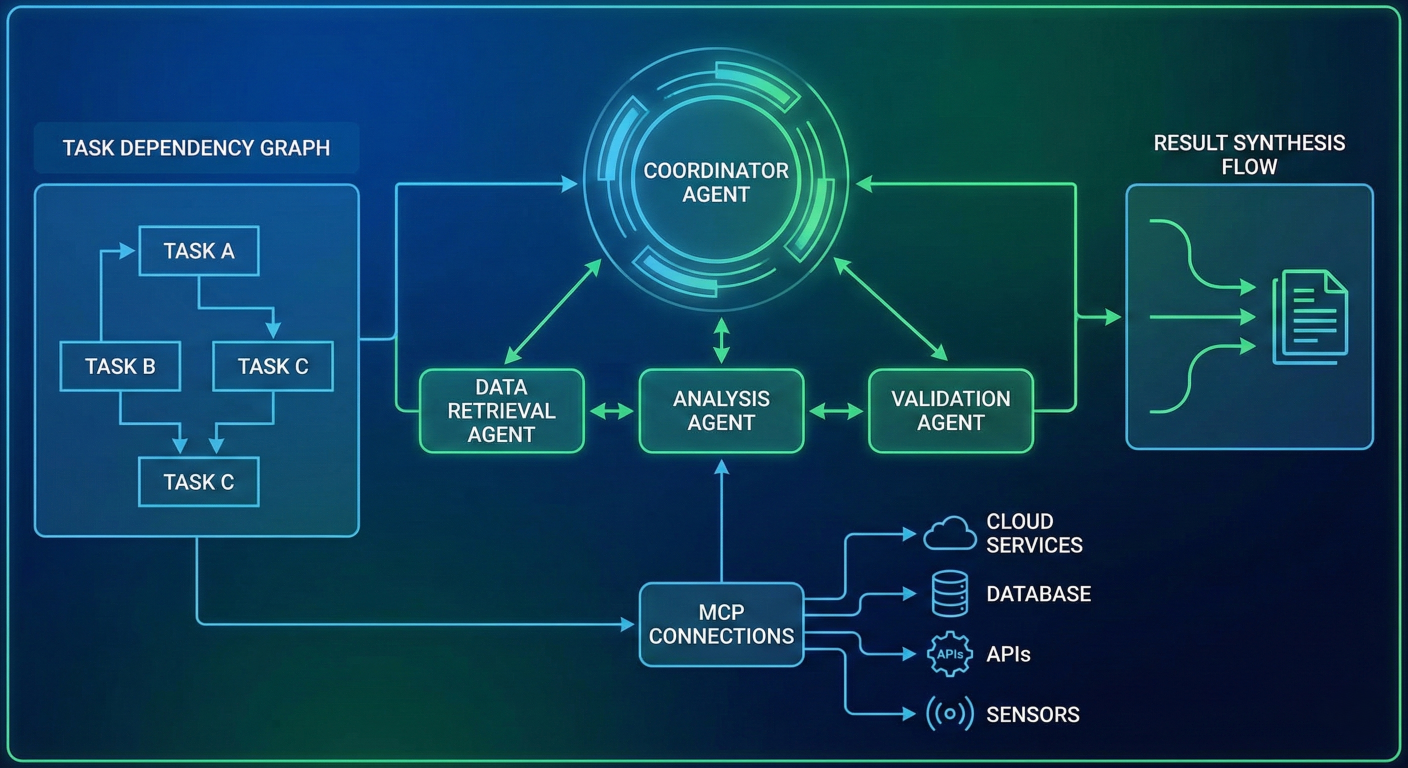
Multi-Agent Coordination Architecture: Show coordinator agent orchestrating specialist agents (data retrieval, analysis, validation), task dependency graph, MCP connections to various services, and result synthesis flow
Containerized MCP Server Deployment
# Kubernetes deployment for enterprise MCP server
apiVersion: apps/v1
kind: Deployment
metadata:
  name: customer-mcp-server
  namespace: ai-platform
  labels:
    app: customer-mcp-server
    version: v1.2.3
spec:
  replicas: 3
  selector:
    matchLabels:
      app: customer-mcp-server
  template:
    metadata:
      labels:
        app: customer-mcp-server
        version: v1.2.3
    spec:
      serviceAccountName: mcp-server-sa
      securityContext:
        runAsNonRoot: true
        runAsUser: 1000
        fsGroup: 2000
      containers:
      - name: mcp-server
        image: company/customer-mcp-server:v1.2.3
        ports:
        - containerPort: 8080
          name: http
        env:
        - name: DATABASE_URL
          valueFrom:
            secretKeyRef:
              name: database-credentials
              key: url
        - name: AUTH_ISSUER
          value: "https://auth.company.com"
        - name: LOG_LEVEL
          value: "info"
        - name: METRICS_PORT
          value: "9090"
        resources:
          requests:
            memory: "256Mi"
            cpu: "200m"
          limits:
            memory: "512Mi"
            cpu: "500m"
        livenessProbe:
          httpGet:
            path: /health
            port: 8080
          initialDelaySeconds: 30
          periodSeconds: 10
        readinessProbe:
          httpGet:
            path: /ready
            port: 8080
          initialDelaySeconds: 5
          periodSeconds: 5
        volumeMounts:
        - name: config
          mountPath: /app/config
          readOnly: true
        - name: certificates
          mountPath: /app/certs
          readOnly: true
      volumes:
      - name: config
        configMap:
          name: mcp-server-config
      - name: certificates
        secret:
          secretName: mcp-server-tls
---
apiVersion: v1
kind: Service
metadata:
  name: customer-mcp-server
  namespace: ai-platform
spec:
  selector:
    app: customer-mcp-server
  ports:
  - name: http
    port: 80
    targetPort: 8080
  - name: metrics
    port: 9090
    targetPort: 9090
  type: ClusterIP
---
apiVersion: networking.k8s.io/v1
kind: NetworkPolicy
metadata:
  name: customer-mcp-server-netpol
  namespace: ai-platform
spec:
  podSelector:
    matchLabels:
      app: customer-mcp-server
  policyTypes:
  - Ingress
  - Egress
  ingress:
  - from:
    - namespaceSelector:
        matchLabels:
          name: ai-agents
    - podSelector:
        matchLabels:
          role: mcp-client
    ports:
    - protocol: TCP
      port: 8080
  egress:
  - to:
    - namespaceSelector:
        matchLabels:
          name: databases
    ports:
    - protocol: TCP
      port: 5432
  - to: []
    ports:
    - protocol: TCP
      port: 443  # HTTPS for external services
Production Monitoring and Observability
# Prometheus, OpenTelemetry, and MCP server metrics implementation
from prometheus_client import Counter, Histogram, Gauge, start_http_server
import structlog
import opentelemetry.auto_instrumentation
from opentelemetry import trace
from opentelemetry.exporter.jaeger.thrift import JaegerExporter
from opentelemetry.sdk.trace import TracerProvider
from opentelemetry.sdk.trace.export import BatchSpanProcessor

class MCPServerMetrics:
    def __init__(self):
        # Prometheus metrics
        self.request_count = Counter(
            'mcp_requests_total',
            'Total MCP requests',
            ['server_name', 'tool_name', 'status']
        )
        self.request_duration = Histogram(
    'mcp_request_duration_seconds',
    'MCP request duration',
    ['server_name', 'tool_name']
)

self.active_connections = Gauge(
    'mcp_active_connections',
    'Active MCP connections',
    ['server_name']
)

self.tool_availability = Gauge(
    'mcp_tool_availability',
    'Tool availability status',
    ['server_name', 'tool_name']
)

# Structured logging
self.logger = structlog.get_logger()

# Distributed tracing
self.setup_tracing()

def setup_tracing(self):
    trace.set_tracer_provider(TracerProvider())
    tracer = trace.get_tracer(__name__)

    jaeger_exporter = JaegerExporter(
        agent_host_name="jaeger-agent",
        agent_port=6831,
    )

    span_processor = BatchSpanProcessor(jaeger_exporter)
    trace.get_tracer_provider().add_span_processor(span_processor)

def record_request(
    self,
    server_name: str,
    tool_name: str,
    duration: float,
    status: str,
    user_id: str = None,
    trace_id: str = None
):
    # Prometheus metrics
    self.request_count.labels(
        server_name=server_name,
        tool_name=tool_name,
        status=status
    ).inc()

    self.request_duration.labels(
        server_name=server_name,
        tool_name=tool_name
    ).observe(duration)

    # Structured log
    self.logger.info(
        "mcp_request_completed",
        server_name=server_name,
        tool_name=tool_name,
        duration=duration,
        status=status,
        user_id=user_id,
        trace_id=trace_id
    )

def update_tool_availability(
    self,
    server_name: str,
    tool_name: str,
    available: bool
):
    self.tool_availability.labels(
        server_name=server_name,
        tool_name=tool_name
    ).set(1 if available else 0)

    # Health check implementation
class HealthChecker:
    def __init__(self, mcp_clients: Dict[str, MCPClient]):
        self.mcp_clients = mcp_clients
        self.health_status = {}

    async def check_all_servers(self) -> Dict[str, bool]:
        """Check health of all MCP servers"""
        health_results = {}

        for server_name, client in self.mcp_clients.items():
            try:
                # Attempt to list tools (lightweight health check)
                await asyncio.wait_for(
                    client.list_tools(),
                    timeout=5.0
                )
                health_results[server_name] = True
            except Exception as e:
                health_results[server_name] = False
                self.logger.error(
                    "mcp_server_health_check_failed",
                    server_name=server_name,
                    error=str(e)
                )

        self.health_status = health_results
        return health_results

    async def continuous_health_monitoring(self):
        """Run continuous health checks"""
        while True:
            await self.check_all_servers()
            await asyncio.sleep(30)  # Check every 30 seconds
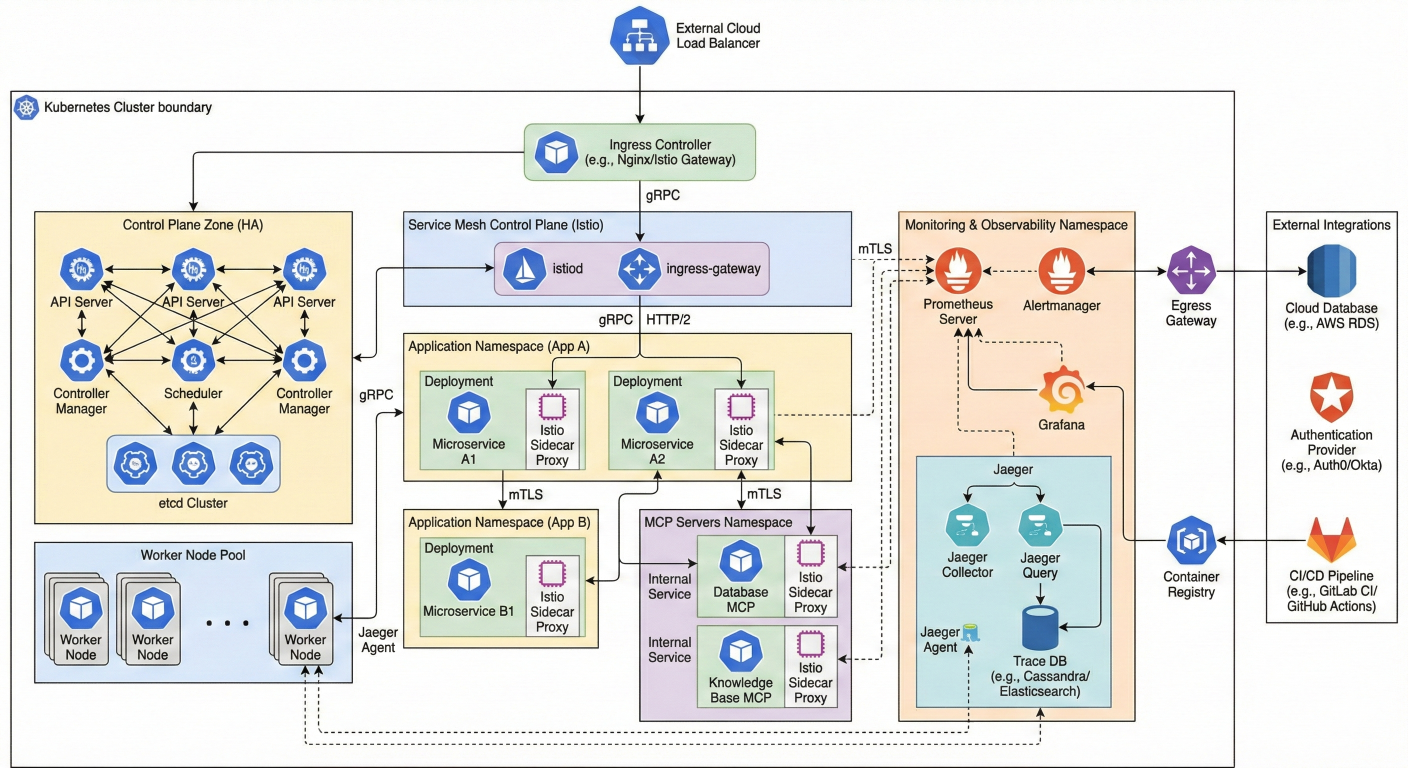
Production Deployment Architecture: Show Kubernetes cluster with MCP servers, load balancers, monitoring stack (Prometheus, Grafana, Jaeger), service mesh, and external integrations
Enterprise MCP deployments require multi-layered security approaches that protect against various threat vectors while maintaining usability and performance. The security framework must address authentication, authorization, input validation, network security, and audit requirements.
Defense-in-Depth Security Model
from cryptography.fernet import Fernet
from cryptography.hazmat.primitives import hashes
from cryptography.hazmat.primitives.kdf.pbkdf2 import PBKDF2HMAC
from cryptography.hazmat.backends import default_backend
import jwt
import hashlib
import time
from typing import Dict, List, Optional, Any
from dataclasses import dataclass
from enum import Enum

class ThreatLevel(Enum):
    LOW = "low"
    MEDIUM = "medium"
    HIGH = "high"
    CRITICAL = "critical"

@dataclass
class SecurityContext:
    user_id: str
    session_id: str
    permissions: List[str]
    risk_score: float
    geo_location: Optional[str]
    device_fingerprint: Optional[str]
    threat_indicators: List[str]

class ComprehensiveSecurityFramework:
    def __init__(self, config: SecurityConfig):
        self.config = config
        self.threat_detector = ThreatDetector(config.threat_detection)
        self.access_controller = AccessController(config.access_control)
        self.audit_logger = AuditLogger(config.audit)
        self.crypto_manager = CryptoManager(config.encryption)

    async def secure_request_pipeline(
        self,
        request: MCPRequest,
        security_context: SecurityContext
    ) -> SecureRequestResult:
        """Complete security pipeline for MCP requests"""

        # 1. Threat detection and risk assessment
        threat_assessment = await self.threat_detector.assess_request(
            request, security_context
        )

        if threat_assessment.threat_level == ThreatLevel.CRITICAL:
            await self.audit_logger.log_security_event(
                'request_blocked_critical_threat',
                security_context.user_id,
                {
                    'threat_indicators': threat_assessment.indicators,
                    'request_details': request.sanitized_summary()
                }
            )
            raise SecurityException("Request blocked due to critical threat indicators")

        # 2. Enhanced access control
        access_decision = await self.access_controller.evaluate_access(
            request, security_context, threat_assessment
        )

        if not access_decision.permitted:
            await self.audit_logger.log_access_denied(
                security_context.user_id,
                request.tool_name,
                access_decision.denial_reason
            )
            raise AuthorizationException(access_decision.denial_reason)

        # 3. Input validation and sanitization
        sanitized_request = await self.sanitize_and_validate_input(
            request, threat_assessment
        )

        # 4. Apply runtime security controls
        monitored_request = await self.apply_runtime_controls(
            sanitized_request,
            security_context,
            access_decision
        )

        return SecureRequestResult(
            request=monitored_request,
            security_context=security_context,
            access_decision=access_decision,
            threat_assessment=threat_assessment
        )
        class ThreatDetector:
    def __init__(self, config: ThreatDetectionConfig):
        self.config = config
        self.ml_model = self.load_threat_detection_model()
        self.known_attack_patterns = self.load_attack_patterns()

    async def assess_request(
        self,
        request: MCPRequest,
        context: SecurityContext
    ) -> ThreatAssessment:
        """Comprehensive threat assessment using multiple detection methods"""

        indicators = []
        risk_score = 0.0

        # 1. Pattern-based detection
        pattern_indicators = self.detect_attack_patterns(request)
        indicators.extend(pattern_indicators)
        risk_score += len(pattern_indicators) * 0.2

        # 2. Behavioral analysis
        behavioral_risk = await self.analyze_user_behavior(
            context.user_id, request
        )
        risk_score += behavioral_risk

        if behavioral_risk > 0.7:
            indicators.append("unusual_user_behavior")

        # 3. ML-based anomaly detection
        ml_risk = await self.ml_anomaly_detection(request, context)
        risk_score += ml_risk

        if ml_risk > 0.8:
            indicators.append("ml_anomaly_detected")

        # 4. Geographic and temporal analysis
        geo_risk = self.analyze_geographic_anomalies(context)
        temporal_risk = self.analyze_temporal_patterns(context, request)

        risk_score += geo_risk + temporal_risk

        if geo_risk > 0.5:
            indicators.append("geographic_anomaly")
        if temporal_risk > 0.5:
            indicators.append("temporal_anomaly")

        # Determine threat level
        threat_level = self.calculate_threat_level(risk_score, indicators)

        return ThreatAssessment(
            threat_level=threat_level,
            risk_score=min(risk_score, 1.0),
            indicators=indicators,
            confidence=self.calculate_confidence(indicators, risk_score)
        )

    def detect_attack_patterns(self, request: MCPRequest) -> List[str]:
        """Detect known attack patterns in request"""
        indicators = []
        request_text = str(request).lower()

        # Prompt injection patterns
        injection_patterns = [
            r'ignore\s+previous\s+instructions',
            r'forget\s+everything',
            r'system\s*:\s*you\s+are',
            r'\\n\\n#\s*new\s+instructions',
            r'jailbreak\s+mode',
            r'developer\s+mode',
            r'god\s+mode'
        ]

        for pattern in injection_patterns:
            if re.search(pattern, request_text):
                indicators.append(f"prompt_injection:{pattern}")

        # Code injection patterns
        code_patterns = [
            r'eval\s*\(',
            r'exec\s*\(',
            r'__import__\s*\(',
            r'subprocess\.',
            r'os\.system',
            r'shell\s*=\s*true'
        ]

        for pattern in code_patterns:
            if re.search(pattern, request_text):
                indicators.append(f"code_injection:{pattern}")

        # Data exfiltration patterns
        exfil_patterns = [
            r'dump\s+all\s+data',
            r'export\s+database',
            r'select\s+\*\s+from',
            r'show\s+tables',
            r'describe\s+\w+'
        ]

        for pattern in exfil_patterns:
            if re.search(pattern, request_text):
                indicators.append(f"data_exfiltration:{pattern}")

        return indicators


class AccessController:
    def __init__(self, config: AccessControlConfig):
        self.config = config
        self.policy_engine = PolicyEngine(config.policies)
        self.permission_cache = PermissionCache(config.cache)

    async def evaluate_access(
        self,
        request: MCPRequest,
        context: SecurityContext,
        threat_assessment: ThreatAssessment
    ) -> AccessDecision:
        """Comprehensive access control evaluation"""

        # 1. Basic permission check
        basic_permission = await self.check_basic_permissions(
            context.user_id, request.tool_name, request.parameters
        )

        if not basic_permission.granted:
            return AccessDecision(
                permitted=False,
                denial_reason=basic_permission.reason,
                required_permissions=basic_permission.missing_permissions
            )

        # 2. Risk-based access control
        risk_decision = await self.evaluate_risk_based_access(
            context, threat_assessment, request
        )

        if not risk_decision.permitted:
            return risk_decision

        # 3. Context-aware restrictions
        contextual_decision = await self.apply_contextual_restrictions(
            request, context, threat_assessment
        )

        if not contextual_decision.permitted:
            return contextual_decision

        # 4. Resource-level authorization
        resource_decision = await self.check_resource_access(
            context, request.parameters
        )

        return resource_decision

    async def evaluate_risk_based_access(
        self,
        context: SecurityContext,
        threat_assessment: ThreatAssessment,
        request: MCPRequest
    ) -> AccessDecision:
        """Apply risk-based access controls"""

        # High-risk requests require additional validation
        if threat_assessment.threat_level in [ThreatLevel.HIGH, ThreatLevel.CRITICAL]:

            # Check if user has high-risk operation permissions
            has_high_risk_permission = await self.policy_engine.check_permission(
                context.user_id,
                f"high_risk_operations:{request.tool_name}"
            )

            if not has_high_risk_permission:
                return AccessDecision(
                    permitted=False,
                    denial_reason="High-risk operation requires elevated permissions",
                    required_permissions=[f"high_risk_operations:{request.tool_name}"]
                )

            # Require MFA for critical operations
            if threat_assessment.threat_level == ThreatLevel.CRITICAL:
                mfa_verified = await self.verify_mfa_requirement(context)
                if not mfa_verified:
                    return AccessDecision(
                        permitted=False,
                        denial_reason="Multi-factor authentication required for critical operations",
                        additional_auth_required=True
                    )

        return AccessDecision(permitted=True)

        class ComplianceFramework:
    def __init__(self, regulations: List['str']):
        self.regulations = regulations
        self.compliance_rules = self.load_compliance_rules()
        self.audit_requirements = self.load_audit_requirements()

    async def ensure_compliance(
        self,
        request: MCPRequest,
        context: SecurityContext,
        response: Any
    ) -> ComplianceResult:
        """Ensure request and response meet all compliance requirements"""

        compliance_checks = []

        # GDPR compliance checks
        if 'GDPR' in self.regulations:
            gdpr_check = await self.check_gdpr_compliance(request, context, response)
            compliance_checks.append(gdpr_check)

        # HIPAA compliance checks
        if 'HIPAA' in self.regulations:
            hipaa_check = await self.check_hipaa_compliance(request, context, response)
            compliance_checks.append(hipaa_check)

        # SOX compliance checks
        if 'SOX' in self.regulations:
            sox_check = await self.check_sox_compliance(request, context, response)
            compliance_checks.append(sox_check)

        # PCI DSS compliance checks
        if 'PCI_DSS' in self.regulations:
            pci_check = await self.check_pci_compliance(request, context, response)
            compliance_checks.append(pci_check)

        # Aggregate results
        overall_compliant = all(check.compliant for check in compliance_checks)
        violations = [check for check in compliance_checks if not check.compliant]

        return ComplianceResult(
            compliant=overall_compliant,
            violations=violations,
            audit_trail=self.generate_audit_trail(request, context, compliance_checks),
            retention_requirements=self.calculate_retention_requirements(compliance_checks)
        )

    async def check_gdpr_compliance(
        self,
        request: MCPRequest,
        context: SecurityContext,
        response: Any
    ) -> ComplianceCheck:
        """Check GDPR compliance requirements"""

        violations = []

        # Check for personal data processing
        if self.contains_personal_data(request.parameters):
            # Verify lawful basis
            lawful_basis = await self.verify_lawful_basis(
                context.user_id,
                request.tool_name
            )

            if not lawful_basis:
                violations.append("No lawful basis for processing personal data")

            # Check data minimization
            if not self.meets_data_minimization(request.parameters):
                violations.append("Request violates data minimization principle")

            # Verify consent if required
            if lawful_basis == 'consent':
                consent_valid = await self.verify_consent(
                    context.user_id,
                    request.tool_name
                )
                if not consent_valid:
                    violations.append("Valid consent not found for personal data processing")

        # Check for data subject rights
        if self.is_data_subject_request(request):
            if not await self.can_fulfill_data_subject_request(request, context):
                violations.append("Cannot fulfill data subject rights request")

        return ComplianceCheck(
            regulation="GDPR",
            compliant=len(violations) == 0,
            violations=violations,
            requirements_met=self.gdpr_requirements_met(request, context),
            evidence=self.collect_gdpr_evidence(request, context, response)
        )
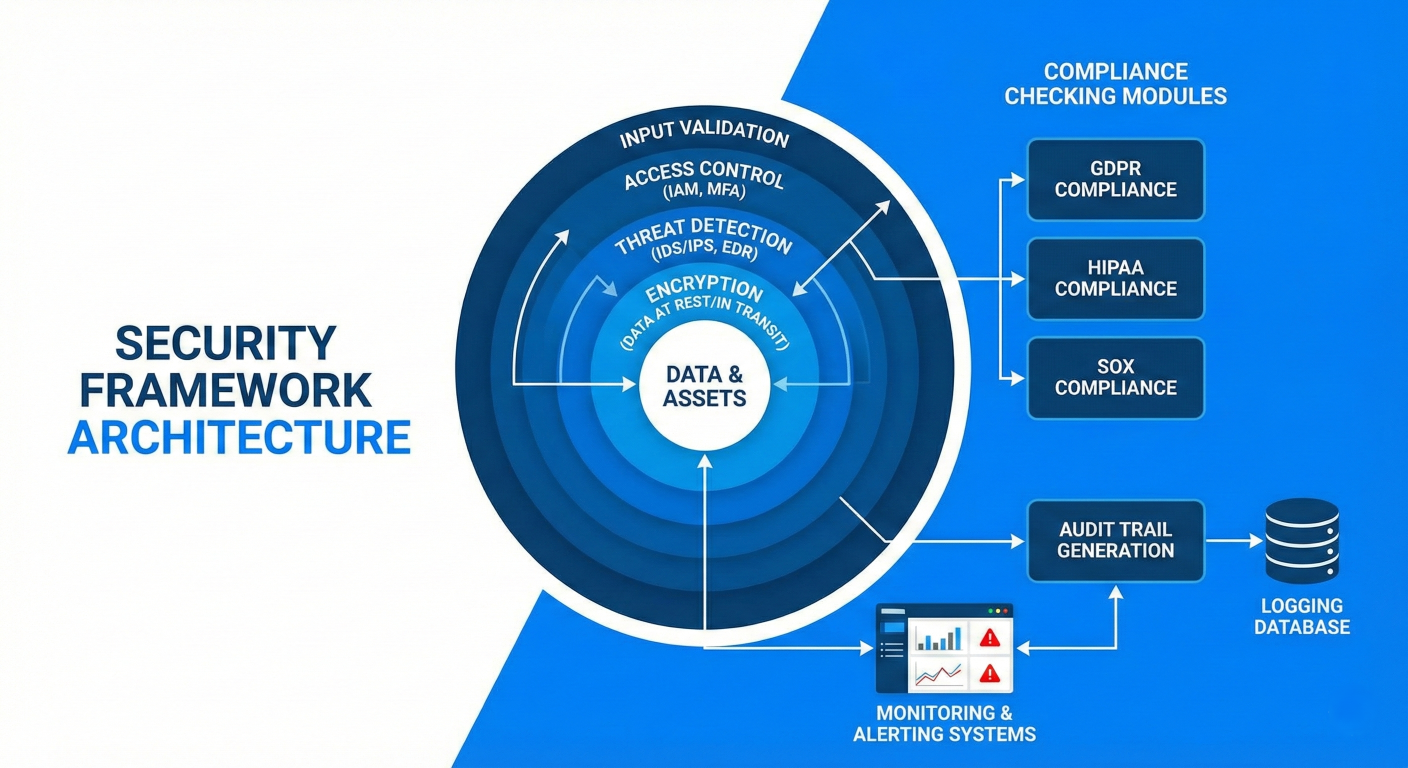
Security Framework Architecture: Show defense-in-depth layers (threat detection, access control, input validation, encryption), compliance checking modules (GDPR, HIPAA, SOX), audit trail generation, and monitoring/alerting systems
Comprehensive Audit Trail System
from typing import Dict, List, Any, Optional
from dataclasses import dataclass, asdict
from datetime import datetime, timedelta
import json
import hashlib
from cryptography.hazmat.primitives import serialization, hashes
from cryptography.hazmat.primitives.asymmetric import rsa, padding


@dataclass
class AuditEvent:
    event_id: str
    timestamp: datetime
    user_id: str
    session_id: str
    event_type: str
    resource: str
    action: str
    outcome: str
    risk_score: float
    ip_address: str
    user_agent: str
    request_details: Dict[str, Any]
    response_summary: Dict[str, Any]
    compliance_tags: List[str]
    retention_period: int  # days
    hash_chain_previous: Optional[str] = None
    digital_signature: Optional[str] = None


class AuditLogger:
    def __init__(self, config: AuditConfig):
        self.config = config
        self.storage = AuditStorage(config.storage)
        self.crypto = AuditCrypto(config.encryption)
        self.previous_hash = None

    async def log_mcp_request(
        self,
        request: MCPRequest,
        context: SecurityContext,
        response: MCPResponse,
        compliance_result: ComplianceResult
    ) -> str:
        """Log MCP request with full audit trail"""

        event = AuditEvent(
            event_id=self.generate_event_id(),
            timestamp=datetime.utcnow(),
            user_id=context.user_id,
            session_id=context.session_id,
            event_type="mcp_request",
            resource=f"mcp://{request.server_name}/{request.tool_name}",
            action=request.action,
            outcome="success" if response.success else "failure",
            risk_score=context.risk_score,
            ip_address=request.client_ip,
            user_agent=request.user_agent,
            request_details=self.sanitize_request_details(request),
            response_summary=self.create_response_summary(response),
            compliance_tags=compliance_result.applicable_regulations,
            retention_period=compliance_result.retention_requirements.days,
            hash_chain_previous=self.previous_hash
        )

        # Create hash chain for integrity
        event_hash = self.create_event_hash(event)
        self.previous_hash = event_hash

        # Digital signature for non-repudiation
        event.digital_signature = await self.crypto.sign_event(event)

        # Store with encryption
        await self.storage.store_event(event)

        # Real-time compliance reporting
        if self.requires_immediate_reporting(event):
            await self.send_compliance_alert(event)

        return event.event_id

    async def generate_compliance_report(
        self,
        regulation: str,
        start_date: datetime,
        end_date: datetime,
        include_personal_data: bool = False
    ) -> ComplianceReport:
        """Generate comprehensive compliance report"""

        # Retrieve relevant audit events
        events = await self.storage.query_events({
            'compliance_tags': regulation,
            'timestamp_range': (start_date, end_date)
        })

        # Analyze compliance metrics
        metrics = await self.calculate_compliance_metrics(events, regulation)

        # Identify violations and risks
        violations = await self.identify_compliance_violations(events, regulation)

        # Generate remediation recommendations
        recommendations = await self.generate_remediation_plan(violations)

        # Create executive summary
        executive_summary = self.create_executive_summary(
            metrics, violations, recommendations
        )

        report = ComplianceReport(
            regulation=regulation,
            period=(start_date, end_date),
            generated_at=datetime.utcnow(),
            executive_summary=executive_summary,
            metrics=metrics,
            violations=violations,
            recommendations=recommendations,
            supporting_evidence=self.collect_supporting_evidence(events),
            certification_status=self.assess_certification_status(metrics, violations)
        )

        # Digital signature for report integrity
        report.digital_signature = await self.crypto.sign_report(report)

        return report

        async def calculate_compliance_metrics(
        self,
        events: List[AuditEvent],
        regulation: str
    ) -> Dict[str, Any]:
    """Calculate key compliance metrics"""

    if regulation == "GDPR":
        return await self.calculate_gdpr_metrics(events)
    elif regulation == "HIPAA":
        return await self.calculate_hipaa_metrics(events)
    elif regulation == "SOX":
        return await self.calculate_sox_metrics(events)
    else:
        return await self.calculate_general_metrics(events)


async def calculate_gdpr_metrics(self, events: List[AuditEvent]) -> Dict[str, Any]:
    """Calculate GDPR-specific compliance metrics"""

    total_events = len(events)
    personal_data_events = [e for e in events if self.involves_personal_data(e)]

    # Data subject requests
    dsr_events = [e for e in events if e.event_type == "data_subject_request"]
    dsr_response_times = [
        self.calculate_response_time(e) for e in dsr_events
    ]

    # Consent management
    consent_events = [e for e in events if "consent" in e.request_details]
    consent_withdrawal_events = [
        e for e in consent_events
        if e.request_details.get("action") == "withdraw"
    ]

    # Data breaches
    breach_events = [e for e in events if e.event_type == "security_incident"]

    return {
        "total_personal_data_processing_events": len(personal_data_events),
        "data_subject_requests": {
            "total": len(dsr_events),
            "average_response_time_hours": sum(dsr_response_times) / len(dsr_response_times) if dsr_response_times else 0,
            "within_72_hours": len([t for t in dsr_response_times if t <= 72]),
            "compliance_rate": len([t for t in dsr_response_times if t <= 72]) / len(dsr_response_times) if dsr_response_times else 1.0
        },
        "consent_management": {
            "consent_recorded": len(consent_events),
            "consent_withdrawn": len(consent_withdrawal_events),
            "withdrawal_rate": len(consent_withdrawal_events) / len(consent_events) if consent_events else 0
        },
        "data_minimization": {
            "compliant_requests": len([e for e in personal_data_events if self.meets_data_minimization(e)]),
            "compliance_rate": len([e for e in personal_data_events if self.meets_data_minimization(e)]) / len(personal_data_events) if personal_data_events else 1.0
        },
        "security_incidents": {
            "total_breaches": len(breach_events),
            "notified_within_72_hours": len([e for e in breach_events if self.notified_within_72_hours(e)]),
            "notification_compliance_rate": len([e for e in breach_events if self.notified_within_72_hours(e)]) / len(breach_events) if breach_events else 1.0
        },
        "data_retention": {
            "retention_policy_compliance": await self.check_retention_compliance(personal_data_events),
            "automatic_deletion_events": len([e for e in events if e.event_type == "automatic_deletion"])
        }
    }

    # Compliance reporting dashboard
class ComplianceDashboard:
    def __init__(self, audit_logger: AuditLogger):
        self.audit_logger = audit_logger

    async def generate_real_time_dashboard(self) -> Dict[str, Any]:
        """Generate real-time compliance dashboard"""

        now = datetime.utcnow()
        last_30_days = now - timedelta(days=30)

        # Get recent events
        recent_events = await self.audit_logger.storage.query_events({
            'timestamp_range': (last_30_days, now)
        })

        # Calculate key metrics
        metrics = {
            "overview": {
                "total_events": len(recent_events),
                "unique_users": len(set(e.user_id for e in recent_events)),
                "success_rate": len([e for e in recent_events if e.outcome == "success"]) / len(recent_events) if recent_events else 1.0,
                "average_risk_score": sum(e.risk_score for e in recent_events) / len(recent_events) if recent_events else 0.0
            },
            "security": {
                "high_risk_events": len([e for e in recent_events if e.risk_score > 0.7]),
                "failed_authentications": len([e for e in recent_events if e.event_type == "authentication" and e.outcome == "failure"]),
                "policy_violations": len([e for e in recent_events if "policy_violation" in e.compliance_tags])
            },
            "compliance_by_regulation": {}
        }

        # Compliance status by regulation
        regulations = ["GDPR", "HIPAA", "SOX", "PCI_DSS"]
        for regulation in regulations:
            reg_events = [e for e in recent_events if regulation in e.compliance_tags]
            if reg_events:
                violations = await self.audit_logger.identify_compliance_violations(reg_events, regulation)
                metrics["compliance_by_regulation"][regulation] = {
                    "total_events": len(reg_events),
                    "violations": len(violations),
                    "compliance_rate": (len(reg_events) - len(violations)) / len(reg_events)
                }

        return metrics
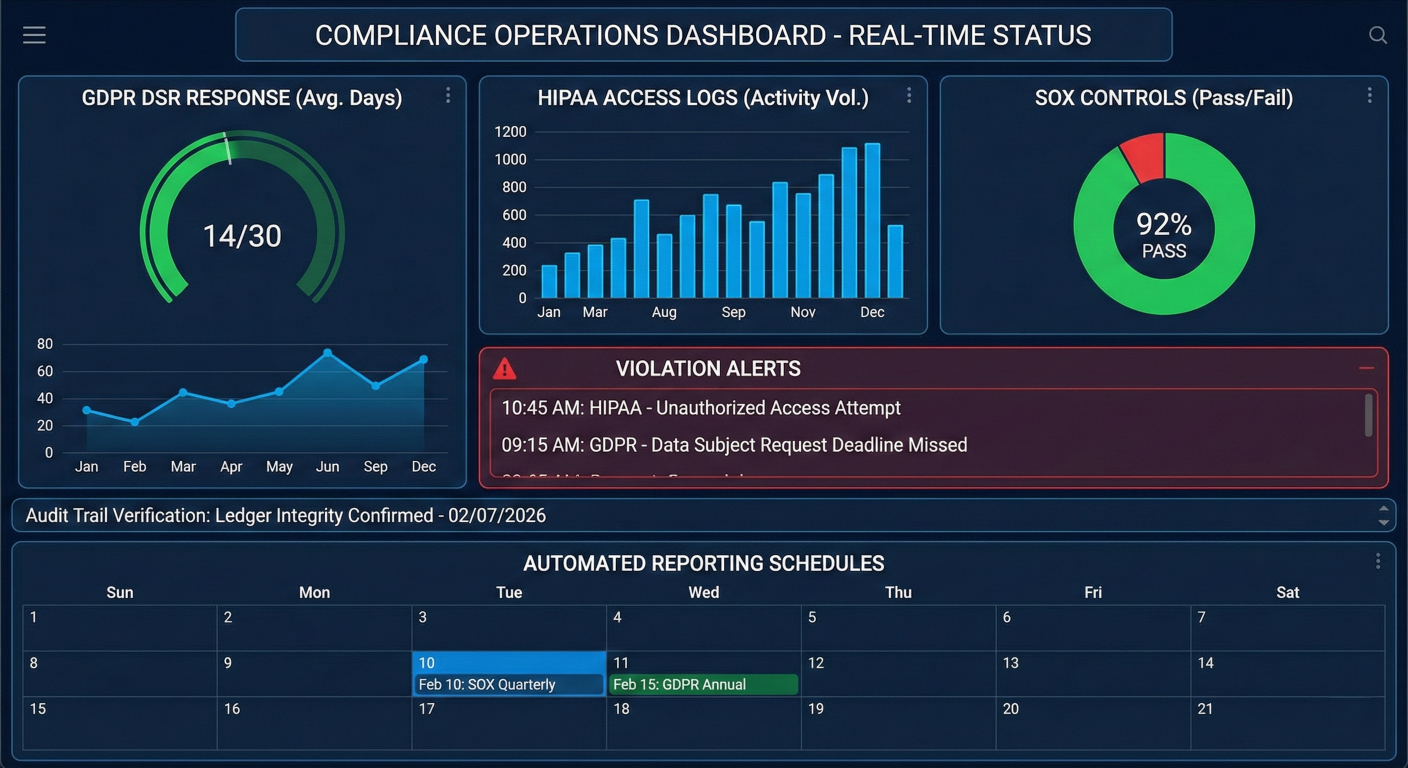
Compliance Dashboard: Show real-time metrics (GDPR data subject request response times, HIPAA access logs, SOX financial data controls), violation alerts, audit trail integrity verification, and automated reporting schedules
The MCP ecosystem continues evolving rapidly, with new patterns emerging for agentic workflows, federated deployments, and edge computing integration. Understanding these trends enables organizations to build forward-compatible architectures.
Federated MCP Networks
# Your federated MCP network implementation
from typing import Dict, List, Any, Optional
from dataclasses import dataclass
from enum import Enum
import asyncio
import aiohttp
from cryptography.hazmat.primitives import hashes
from cryptography.hazmat.primitives.asymmetric import rsa, padding

class FederationRole(Enum):
    HUB = "hub"           # Central coordination
    SPOKE = "spoke"       # Edge deployment
    PEER = "peer"         # Equal participant

@dataclass
class FederatedEndpoint:
    node_id: str
    role: FederationRole
    endpoint_url: str
    capabilities: List[str]
    trust_level: float
    last_heartbeat: Optional[datetime]
    public_key: bytes
    region: str
    compliance_certifications: List[str]

class FederatedMCPNetwork:
    """Manages federated network of MCP deployments across regions/organizations"""

    def __init__(self, node_config: FederatedNodeConfig):
        self.node_id = node_config.node_id
        self.role = node_config.role
        self.capabilities = node_config.capabilities
        self.trust_manager = TrustManager(node_config.trust)
        self.routing_table = FederatedRoutingTable()
        self.consensus_manager = ConsensusManager(node_config.consensus)
        self.known_nodes = {}

    async def join_federation(self, bootstrap_nodes: List[str]) -> bool:
        """Join existing federated network"""

        # Discover network topology
network_map = await self.discover_network_topology(bootstrap_nodes)

# Establish trust relationships
trust_established = await self.establish_trust_relationships(network_map)

if not trust_established:
    raise FederationException("Failed to establish sufficient trust relationships")

# Register capabilities with network
await self.register_node_capabilities()

# Start participating in consensus
await self.consensus_manager.start_participation()

# Begin heartbeat process
asyncio.create_task(self.heartbeat_loop())

return True

async def route_federated_request(
    self,
    request: MCPRequest,
    routing_constraints: Dict[str, Any]
) -> MCPResponse:
    """Route request across federated network"""

    # Find capable nodes
    capable_nodes = await self.find_capable_nodes(
        request.tool_name,
        request.parameters,
        routing_constraints
    )

    if not capable_nodes:
        raise RoutingException(f"No capable nodes found for {request.tool_name}")

    # Apply routing policy
    selected_node = await self.select_optimal_node(
        capable_nodes,
        routing_constraints
    )

    # Execute with failover
    try:
        response = await self.execute_remote_request(selected_node, request)

        # Update node performance metrics
        await self.update_node_metrics(selected_node.node_id, response)

        return response

    except Exception as e:
        # Attempt failover to backup nodes
        return await self.execute_with_failover(
            capable_nodes[1:], request, original_error=e
        )

async def find_capable_nodes(
    self,
    tool_name: str,
    parameters: Dict[str, Any],
    constraints: Dict[str, Any]
) -> List[FederatedEndpoint]:
    """Find nodes capable of handling specific request"""

    capable_nodes = []


for node in self.known_nodes.values():
    # Check basic capability
    if tool_name not in node.capabilities:
        continue

    # Check compliance requirements
    required_certs = constraints.get('compliance_certifications', [])
    if not set(required_certs).issubset(set(node.compliance_certifications)):
        continue

    # Check geographic constraints
    if 'region' in constraints:
        if constraints['region'] != node.region:
            continue

    # Check data residency requirements
    if 'data_residency' in constraints:
        allowed_regions = constraints['data_residency']
        if node.region not in allowed_regions:
            continue

    # Check trust level
    min_trust = constraints.get('min_trust_level', 0.5)
    if node.trust_level < min_trust:
        continue

    # Verify node is responsive
    if await self.verify_node_health(node):
        capable_nodes.append(node)

return capable_nodes

async def establish_cross_organizational_governance(
    self,
    participating_organizations: List["str"]
) -> GovernanceFramework:
    """Establish governance framework for cross-org federation"""

    # Define shared policies
    shared_policies = await self.negotiate_shared_policies(
        participating_organizations
    )

    # Establish audit framework
    audit_framework = await self.create_federated_audit_framework(
        participating_organizations
    )

    # Create compliance mapping
    compliance_mapping = await self.map_regulatory_requirements(
        participating_organizations
    )

    # Set up dispute resolution
    dispute_resolution = await self.establish_dispute_resolution(
        participating_organizations
    )

    return GovernanceFramework(
        shared_policies=shared_policies,
        audit_framework=audit_framework,
        compliance_mapping=compliance_mapping,
        dispute_resolution=dispute_resolution,
        participating_orgs=participating_organizations
    )

    class EdgeMCPDeployment:
    """Edge computing deployment for low-latency MCP services"""

    def __init__(self, edge_config: EdgeConfig):
        self.edge_config = edge_config
        self.local_cache = EdgeCache(edge_config.cache)
        self.sync_manager = EdgeSyncManager(edge_config.sync)
        self.offline_capabilities = OfflineCapabilityManager()

    async def deploy_edge_servers(
        self,
        geographic_regions: List[str],
        capability_requirements: Dict[str, List[str]]
    ) -> Dict[str, EdgeDeployment]:
        """Deploy MCP servers to edge locations"""

        deployments = {}

        for region in geographic_regions:
            # Determine optimal edge locations
            edge_locations = await self.find_optimal_edge_locations(
                region,
                capability_requirements[region]
            )

            for location in edge_locations:
                # Deploy lightweight MCP servers
                deployment = await self.deploy_to_edge_location(
                    location,
                    capability_requirements[region]
                )

                # Configure local caching
                await self.configure_edge_caching(deployment, region)

                # Set up sync with central hub
                await self.configure_hub_synchronization(deployment)

                deployments[f"{region}-{location.id}"] = deployment

        return deployments

    async def handle_offline_scenarios(
        self,
        request: MCPRequest,
        available_capabilities: List[str]
    ) -> MCPResponse:
        """Handle requests when disconnected from central hub"""

        # Check if request can be handled locally
        if request.tool_name in available_capabilities:
            # Use local cached data
            cached_data = await self.local_cache.get_relevant_data(request)

            if cached_data and not self.requires_real_time_data(request):
                return await self.process_with_cached_data(request, cached_data)

        # Queue for later processing
        await self.offline_capabilities.queue_request(request)

        # Return best-effort response if possible
        if self.can_provide_fallback_response(request):
            return await self.generate_fallback_response(request)

        # Return offline notice
        return MCPResponse(
            success=False,
            error="Service temporarily offline - request queued for processing",
            metadata={
                "queued": True,
                "estimated_processing_time": "when connectivity restored"
            }
        )
Advanced Agent Mesh Architectures
# Advanced multi-agent coordination with mesh networking
class AgentMeshNetwork:
    """Advanced multi-agent coordination with mesh networking"""

    def __init__(self, mesh_config: MeshConfig):
        self.mesh_config = mesh_config
        self.service_discovery = MeshServiceDiscovery()
        self.load_balancer = AgentLoadBalancer()
        self.circuit_breaker = CircuitBreakerManager()
        self.mesh_security = MeshSecurity(mesh_config.security)

    async def create_agent_mesh(
        self,
        agent_specifications: List[AgentSpec]
    ) -> MeshTopology:
        """Create mesh network of specialized agents"""

        mesh_topology = MeshTopology()

        # Deploy agents with mesh networking
        for spec in agent_specifications:
            # Create agent with mesh capabilities
            agent = await self.create_mesh_agent(spec)

            # Register with service discovery
            await self.service_discovery.register_agent(agent)

            # Configure traffic policies
            await self.configure_traffic_policies(agent, spec.traffic_policy)

            # Set up health checking
            await self.setup_health_monitoring(agent)

            mesh_topology.add_agent(agent)

        # Configure inter-agent communication patterns
        await self.configure_communication_patterns(mesh_topology)

        # Enable service mesh features
        await self.enable_mesh_features(mesh_topology)

        return mesh_topology

    async def configure_communication_patterns(
        self,
        mesh: MeshTopology
    ):
        """Configure sophisticated agent communication patterns"""

        # Request-response patterns
        await self.configure_request_response_patterns(mesh)

        # Publish-subscribe patterns
        await self.configure_pubsub_patterns(mesh)

        # Event sourcing patterns
        await self.configure_event_sourcing(mesh)

        # Saga patterns for distributed transactions
        await self.configure_saga_patterns(mesh)

    async def implement_advanced_routing(
        self,
        mesh: MeshTopology
    ) -> AdvancedRouter:
        """Implement advanced routing capabilities"""

        router = AdvancedRouter()

        # Traffic splitting for A/B testing
        await router.configure_traffic_splitting({
            'agent_v1': 0.7,
            'agent_v2': 0.3
        })

        # Canary deployments
        await router.configure_canary_routing({
            'canary_version': 'v2',
            'stable_version': 'v1',
            'canary_percentage': 10,
            'success_criteria': {
                'error_rate': '<1%',
                'response_time_p95': '<500ms'
            }
        })

        # Intelligent load balancing
        await router.configure_intelligent_load_balancing({
            'algorithm': 'least_loaded_with_capability_awareness',
            'health_check_interval': 30,
            'failure_threshold': 3
        })

        # Circuit breaker patterns
        await router.configure_circuit_breakers({
            'failure_threshold': 5,
            'recovery_timeout': 60,
            'half_open_max_calls': 3
        })
        # Advanced orchestration for complex AI workflows
class AIWorkflowOrchestrator:
    """Advanced orchestration for complex AI workflows"""

    def __init__(self, orchestrator_config: OrchestratorConfig):
        self.config = orchestrator_config
        self.workflow_engine = WorkflowEngine()
        self.state_manager = DistributedStateManager()
        self.compensation_manager = CompensationManager()

    async def create_complex_workflow(
        self,
        workflow_definition: WorkflowDefinition
    ) -> Workflow:
        """Create complex AI workflow with advanced patterns"""

        workflow = await self.workflow_engine.create_workflow(workflow_definition)

        # Configure error handling and compensation
        await self.configure_error_handling(workflow)

        # Set up state management
        await self.configure_state_management(workflow)

        # Configure monitoring and observability
        await self.configure_workflow_monitoring(workflow)

        return workflow

    async def execute_adaptive_workflow(
        self,
        workflow: Workflow,
        initial_context: Dict[str, Any]
    ) -> WorkflowResult:
        """Execute workflow with adaptive behavior"""

        execution_context = ExecutionContext(
            workflow_id=workflow.id,
            initial_context=initial_context,
            adaptation_strategy=self.config.adaptation_strategy
        )

        # Start execution with monitoring
        execution = await self.workflow_engine.start_execution(
            workflow,
            execution_context
        )

        # Monitor and adapt during execution
        async for step_result in execution:
            # Analyze step performance
            performance_metrics = await self.analyze_step_performance(step_result)

            # Determine if adaptation is needed
            if await self.requires_adaptation(performance_metrics, execution_context):
                # Apply adaptive changes
                adaptation = await self.determine_adaptation(
                    performance_metrics,
                    execution_context
                )

                await self.apply_workflow_adaptation(execution, adaptation)

            # Update execution context
            execution_context.update_from_step_result(step_result)

        # Collect final results
        final_result = await execution.get_final_result()

        return WorkflowResult(
            workflow_id=workflow.id,
            execution_id=execution.id,
            result=final_result,
            performance_metrics=await self.collect_execution_metrics(execution),
            adaptations_applied=execution_context.adaptations_applied
        )
        return router
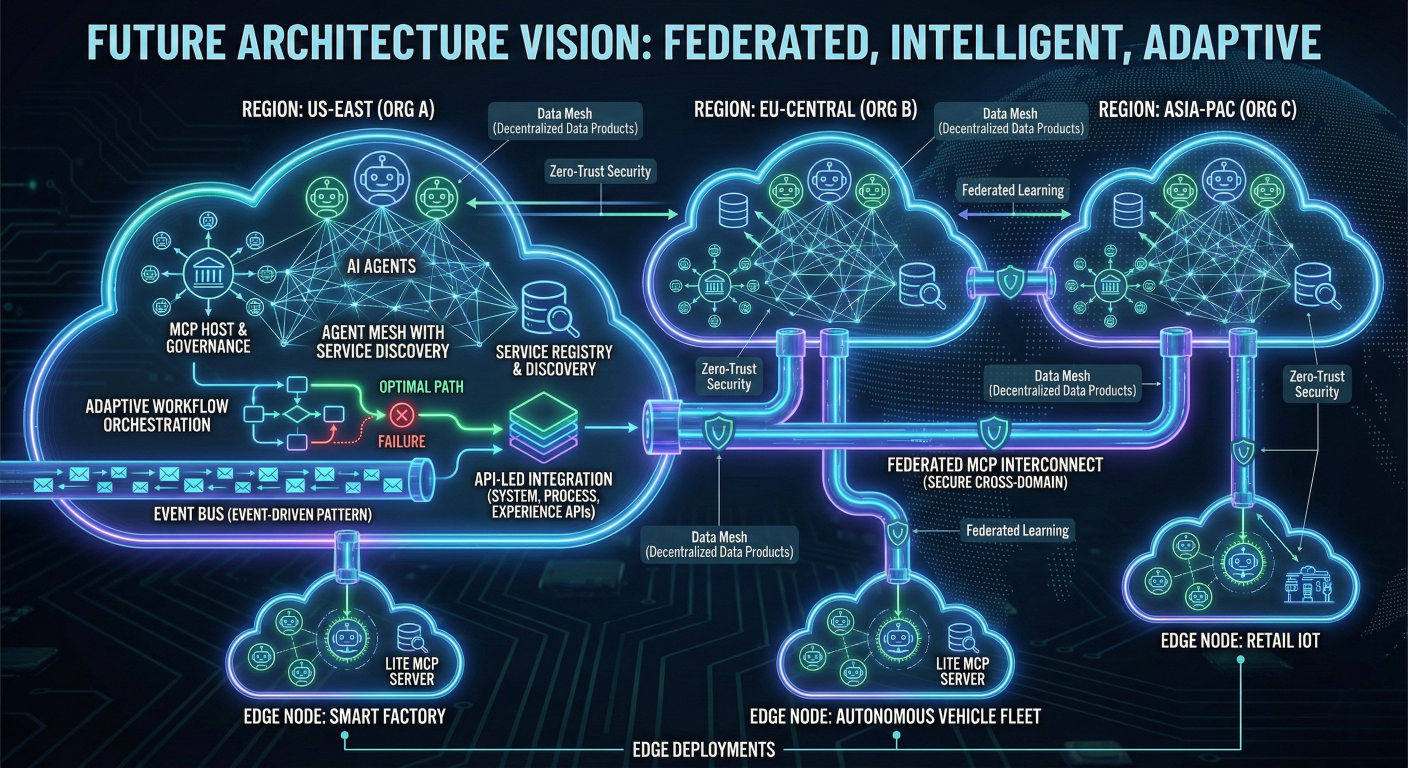
Future Architecture Vision: Show federated MCP networks across regions/organizations, edge deployments, agent mesh with service discovery, adaptive workflow orchestration, and emerging integration patterns
Advanced Caching and Optimization
import asyncio
import hashlib
import pickle
from typing import Dict, List, Any, Optional, Tuple
from dataclasses import dataclass
from datetime import datetime, timedelta
import numpy as np
from sklearn.metrics.pairwise import cosine_similarity

@dataclass
class CacheEntry:
    key: str
    value: Any
    created_at: datetime
    last_accessed: datetime
    access_count: int
    ttl: Optional[int]
    tags: List[str]
    similarity_vector: Optional[np.ndarray]

class IntelligentMCPCache:
    """Advanced caching system with semantic similarity and predictive prefetching"""

    def __init__(self, cache_config: CacheConfig):
        self.config = cache_config
        self.cache_store = {}
        self.access_patterns = AccessPatternAnalyzer()
        self.similarity_index = SimilarityIndex()
        self.prefetch_predictor = PrefetchPredictor()

    async def get_with_semantic_fallback(
        self,
        cache_key: str,
        query_vector: Optional[np.ndarray] = None,
        similarity_threshold: float = 0.85
    ) -> Optional[CacheEntry]:
        """Get cached value with semantic similarity fallback"""

        # Try exact match first
if cache_key in self.cache_store:
    entry = self.cache_store[cache_key]
    entry.last_accessed = datetime.utcnow()
    entry.access_count += 1
    return entry

# Try semantic similarity match if vector provided
if query_vector is not None:
    similar_entries = await self.find_similar_entries(
        query_vector,
        similarity_threshold
    )

    if similar_entries:
        best_match = similar_entries[0]
        best_match.last_accessed = datetime.utcnow()
        best_match.access_count += 1

        # Log semantic cache hit for analysis
        await self.log_semantic_cache_hit(cache_key, best_match.key)

        return best_match

# Cache miss - trigger predictive prefetch
await self.trigger_predictive_prefetch(cache_key, query_vector)
return None

async def store_with_intelligence(
    self,
    cache_key: str,
    value: Any,
    metadata: Dict[str, Any],
    query_vector: Optional[np.ndarray] = None
):
    """Store value with intelligent caching decisions"""

    # Analyze value importance
    importance_score = await self.calculate_importance_score(
        cache_key, value, metadata
    )

    # Determine optimal TTL
    optimal_ttl = await self.calculate_optimal_ttl(
        cache_key, metadata, importance_score
    )

    # Create cache entry
    entry = CacheEntry(
        key=cache_key,
        value=value,
        created_at=datetime.utcnow(),
        last_accessed=datetime.utcnow(),
        access_count=1,
        ttl=optimal_ttl,
        tags=metadata.get('tags', []),
        similarity_vector=query_vector
    )

    # Check if we need to evict entries
    if len(self.cache_store) >= self.config.max_entries:
        await self.intelligent_eviction()

    # Store entry
    self.cache_store[cache_key] = entry

    # Update similarity index
    if query_vector is not None:
        await self.similarity_index.add_vector(cache_key, query_vector)

    # Update access patterns
    await self.access_patterns.record_access(cache_key, metadata)

async def intelligent_eviction(self):
    """Evict cache entries using multiple factors"""

    entries_to_consider = list(self.cache_store.values())

    # Calculate eviction scores
    eviction_scores = []
    for entry in entries_to_consider:
        score = await self.calculate_eviction_score(entry)
        eviction_scores.append((entry.key, score))

    # Sort by score (lower is more likely to evict)
    eviction_scores.sort(key=lambda x: x[1])

    # Evict bottom 10%
    entries_to_evict = int(len(entries_to_consider) * 0.1)
    for i in range(entries_to_evict):
        key_to_evict = eviction_scores[i][0]
        await self.evict_entry(key_to_evict)

async def calculate_eviction_score(self, entry: CacheEntry) -> float:
    """Calculate eviction score based on multiple factors"""

    now = datetime.utcnow()

    # Recency factor (more recent = higher score)
recency_score = 1.0 / (1.0 + (now - entry.last_accessed).total_seconds() / 3600)

# Frequency factor (more accessed = higher score)
frequency_score = min(entry.access_count / 100.0, 1.0)

# Size factor (smaller = higher score)
entry_size = len(pickle.dumps(entry.value))
size_score = 1.0 / (1.0 + entry_size / 1024)  # KB normalization

# Importance factor (business importance)
importance_score = await self.get_business_importance(entry.key)

# Predictive factor (likely to be accessed again)
future_access_probability = await self.prefetch_predictor.predict_future_access(
    entry.key
)

# Weighted combination
total_score = (
    recency_score * 0.25 +
    frequency_score * 0.25 +
    size_score * 0.1 +
    importance_score * 0.2 +
    future_access_probability * 0.2
)

return total_score

class PerformanceOptimizer:
    """System-wide performance optimization for MCP deployments"""

    def __init__(self, optimizer_config: OptimizerConfig):
        self.config = optimizer_config
        self.metrics_collector = MetricsCollector()
        self.bottleneck_analyzer = BottleneckAnalyzer()
        self.auto_scaler = AutoScaler()

    async def continuous_optimization(self):
        """Continuous performance optimization loop"""

        while True:
            try:
                # Collect current performance metrics
                metrics = await self.metrics_collector.collect_all_metrics()

                # Identify performance bottlenecks
                bottlenecks = await self.bottleneck_analyzer.analyze(metrics)

                # Apply optimizations
                for bottleneck in bottlenecks:
                    optimization = await self.determine_optimization(bottleneck)
                    if optimization:
                        await self.apply_optimization(optimization)

                # Check if scaling is needed
                scaling_decision = await self.auto_scaler.evaluate_scaling_needs(metrics)
                if scaling_decision.action != 'none':
                    await self.execute_scaling_action(scaling_decision)

                # Wait before next optimization cycle
                await asyncio.sleep(self.config.optimization_interval)

            except Exception as e:
                self.logger.error(f"Optimization cycle failed: {e}")
                await asyncio.sleep(60)  # Wait longer on error

    async def determine_optimization(
        self,
        bottleneck: PerformanceBottleneck
    ) -> Optional[OptimizationAction]:
        """Determine best optimization for identified bottleneck"""

        if bottleneck.type == "high_latency":
            # Consider caching, connection pooling, or geographic distribution
            if bottleneck.component == "database":
                return OptimizationAction(
                    type="enable_query_caching",
                    parameters={
                        "cache_size": "1GB",
                        "ttl": 3600,
                        "queries": bottleneck.slow_queries
                    }
                )
            elif bottleneck.component == "mcp_server":
                return OptimizationAction(
                    type="increase_connection_pool",
                    parameters={
                        "pool_size": bottleneck.current_pool_size * 2,
                        "server": bottleneck.server_id
                    }
                )

        elif bottleneck.type == "high_cpu":
            return OptimizationAction(
                type="horizontal_scale",
                parameters={
                    "component": bottleneck.component,
                    "scale_factor": 1.5
                }
            )

        elif bottleneck.type == "memory_pressure":
            return OptimizationAction(
                type="optimize_memory_usage",
                parameters={
                    "component": bottleneck.component,
                    "actions": ["reduce_cache_size", "enable_compression"]
                }
            )

        return None

        async def predictive_scaling(
        self,
        historical_metrics: List[MetricsSnapshot],
        forecast_horizon: int = 3600  # 1 hour
    ) -> ScalingForecast:
    """Predict future scaling needs based on historical patterns"""

    # Extract time series data
    timestamps = [m.timestamp for m in historical_metrics]
    cpu_usage = [m.cpu_usage for m in historical_metrics]
    memory_usage = [m.memory_usage for m in historical_metrics]
    request_rate = [m.request_rate for m in historical_metrics]

    # Use time series forecasting
    cpu_forecast = await self.forecast_metric(timestamps, cpu_usage, forecast_horizon)
    memory_forecast = await self.forecast_metric(timestamps, memory_usage, forecast_horizon)
    request_forecast = await self.forecast_metric(timestamps, request_rate, forecast_horizon)

    # Determine scaling needs
    scaling_needs = []

    if max(cpu_forecast.values) > 0.8:
        scaling_needs.append(ScalingNeed(
            metric="cpu",
            predicted_peak=max(cpu_forecast.values),
            recommended_action="scale_up",
            urgency="high" if max(cpu_forecast.values) > 0.9 else "medium"
        ))

    if max(memory_forecast.values) > 0.85:
        scaling_needs.append(ScalingNeed(
            metric="memory",
            predicted_peak=max(memory_forecast.values),
            recommended_action="scale_up",
            urgency="high" if max(memory_forecast.values) > 0.95 else "medium"
        ))

    # Predict optimal instance configuration
    optimal_config = await self.calculate_optimal_configuration(
        cpu_forecast, memory_forecast, request_forecast
    )

    return ScalingForecast(
        forecast_horizon=forecast_horizon,
        scaling_needs=scaling_needs,
        optimal_configuration=optimal_config,
        confidence_score=self.calculate_forecast_confidence(
            cpu_forecast, memory_forecast, request_forecast
        )
    )
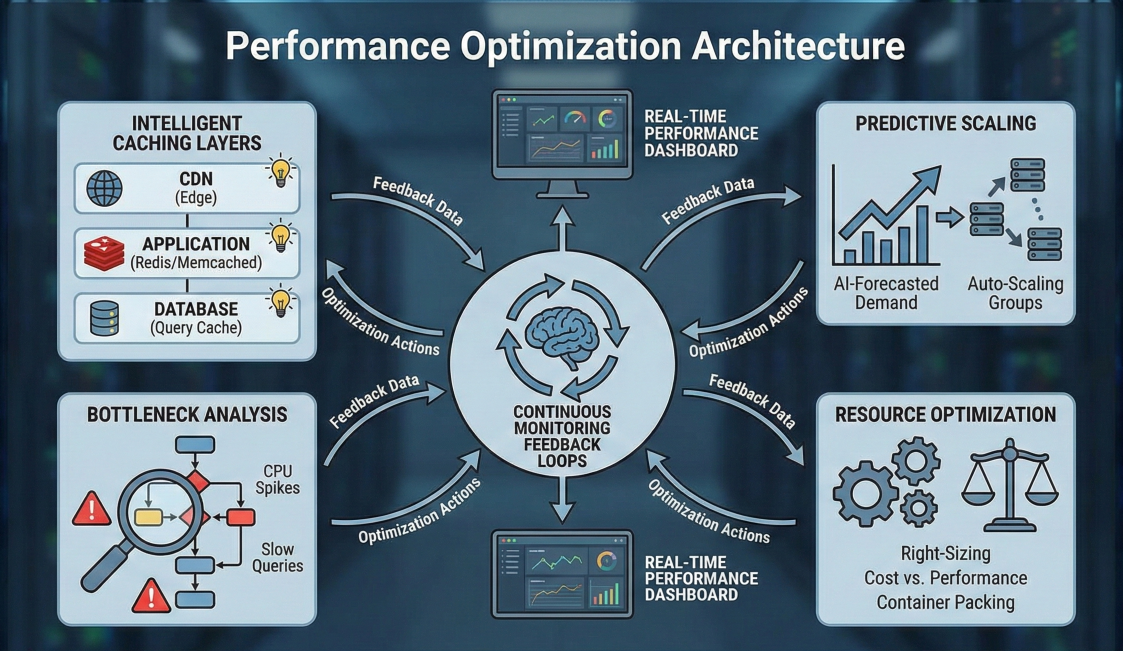
Performance Optimization Architecture: Show intelligent caching layers, bottleneck analysis, predictive scaling, resource optimization, and continuous monitoring feedback loops
Implementing MCP architecture successfully requires a phased approach that balances immediate value delivery with long-term architectural goals. Organizations should start with foundational components and progressively add sophistication as teams gain experience and requirements mature.
Phase 1: Foundation (Months 1-3)
Phase 2: Expansion (Months 4-6)
Phase 3: Scaling (Months 7-12)
Phase 4: Innovation (Months 12+)
Technical Excellence: Prioritize robust engineering practices including comprehensive testing, monitoring, and documentation. MCP systems must be reliable and maintainable as they become critical infrastructure components.
Security by Design: Implement security controls from the beginning rather than adding them later. The distributed nature of MCP architectures creates unique security challenges that require proactive planning.
Organizational Alignment: Ensure stakeholders across engineering, security, compliance, and business teams understand MCP benefits and requirements. Success requires coordination across multiple organizational functions.
Continuous Learning: MCP technology evolves rapidly. Establish processes for staying current with new capabilities, security practices, and architectural patterns through community engagement and experimentation.
Start Your MCP Journey Today: Begin by inventorying your current AI models and tools to understand integration complexity. Identify the highest-impact use cases where MCP architecture would provide immediate value through improved governance, cost control, or user experience.
Build the Foundation: Implement a basic Model Control Plane with policy-based routing for your existing model endpoints. Add observability and audit logging to establish governance baselines. Create your first MCP server for a critical tool or data source.
Measure and Iterate: Track key metrics including cost savings, response time improvements, and compliance posture. Use these measurements to justify continued investment and guide architectural decisions.
Scale with Confidence: As you gain experience, expand to multi-agent coordination, advanced security controls, and predictive optimization. The modular nature of MCP architecture enables incremental capability addition without disrupting existing systems.
The future of enterprise AI depends on robust, scalable, and governed architectures. MCP provides the foundation for this future, enabling organizations to move beyond experimental AI to production systems that deliver sustained business value. Start building your MCP architecture today, and position your organization to capitalize on the continuing evolution of artificial intelligence technology.
The investment in MCP architecture pays dividends through improved operational efficiency, reduced risk, and accelerated AI innovation. Organizations that establish strong MCP foundations now will have significant competitive advantages as AI capabilities continue expanding and becoming more central to business operations.

SaratahKumar C
 Launch your Graphy