
menu
logo
Courses Blog About Solutions Home Login

Mastering MLOps: A Deep Dive for Intermediate Learners

In the rapidly evolving landscape of artificial intelligence and machine learning, developing powerful models is only half the battle. The true challenge lies in reliably deploying, scaling, and maintaining these models in real-world production environments. This is precisely where MLOps, or Machine Learning Operations, enters the picture. MLOps is not just a buzzword; it represents a fundamental shift in how organizations approach the entire machine learning lifecycle, transforming experimental endeavors into robust, operationalized systems.

This detailed guide aims to demystify MLOps for intermediate learners, exploring its core principles, maturity levels, essential components, and popular tools. By understanding these deeper concepts, practitioners can bridge the gap between ML development and operations, ensuring their AI initiatives deliver sustained value.

1. The MLOps Revolution: Bridging the Gap Between ML Development and Operations

What is MLOps?

MLOps is an engineering discipline designed to unify the development (Dev) and operations (Ops) of machine learning systems. Its primary objective is to standardize and streamline the continuous delivery of high-performing models in production environments. Essentially, MLOps applies the well-established principles of DevOps—such as automation, continuous integration, and continuous delivery—to the unique complexities inherent in machine learning applications. The overarching aim is to automate the entire ML lifecycle, from initial data ingestion to final model deployment, while continuously versioning, validating, and monitoring models to ensure their reliability and effectiveness.

This approach signifies more than just adopting new software tools; it represents a profound cultural and organizational transformation. It necessitates a fundamental change in how data scientists, ML engineers, and operations teams collaborate and perceive their roles within the ML lifecycle. The focus shifts from isolated model development to a shared responsibility for integrated, production-ready systems. This broader implication means that organizations embarking on an MLOps journey must invest not only in the right technologies but also in fostering cross-functional collaboration, dismantling traditional silos, and cultivating a collective understanding of the end-to-end ML system. This cultural alignment often presents a more significant hurdle than the technical implementation itself.

Why MLOps Matters: The Challenges of Productionizing ML Models

Despite the significant investment in data science, a substantial number of machine learning projects—approximately 75%—never successfully transition from experimental stages to full production, or they incur considerable resource and time overruns. This high failure rate stems from a critical misunderstanding: producing an ML model is merely the initial step in a much longer and more complex process of integrating data science into operational business applications.

Traditional data science workflows often involve manual, experimental work conducted within isolated Jupyter notebooks. This approach frequently leads to several critical issues, including models remaining perpetually in development environments, manual and error-prone retraining processes, a complete lack of traceability for data and models, and significant difficulties in scaling experiments or fostering effective team collaboration.

The core challenges that MLOps seeks to address are multifaceted:

  • Data Wrangling and Preparation: Data scientists often spend a disproportionate amount of their time on the laborious tasks of cleaning, transforming, and organizing raw data, diverting focus from core data science activities.
  • Managing Software Packages and Frameworks: The diverse and often conflicting dependencies of various software packages and ML frameworks introduce considerable complexity in managing consistent environments. 
  • Configuring Infrastructure: Setting up and maintaining the underlying infrastructure required for ML model training and serving is another time-consuming and specialized activity. 
  • Integrating Various Components: Connecting disparate tools and systems across the ML pipeline, from data sources to deployment endpoints, adds layers of integration complexity.
  • Scaling Issues: Many tools designed for in-memory processing of sample data cannot operate effectively at scale, necessitating a complete re-architecture for distributed platforms and structured databases when moving to production.
  • Duplication of Feature Extraction: Different teams or projects frequently duplicate the same feature engineering efforts, leading to inefficiencies and inconsistencies, especially when underlying datasets evolve.
  • Training-Serving Skew and Real-world Data Discrepancies: Models trained on historical or sample data often perform poorly when exposed to real-time production data due to subtle differences in data distribution or preparation methodologies. This "training-serving skew" is a common pitfall.
  • Latency and Computation Constraints: Real-time applications demand fundamentally different data pipelines, relying on stream processing, fast key/value stores, and time-series databases to deliver real-time feature vectors with low latency.

These challenges collectively represent what has been termed "hidden technical debt" in machine learning systems. This debt accumulates over time, making ML applications brittle, expensive to maintain, and difficult to evolve. MLOps directly confronts these issues by providing a structured framework and a suite of tools that automate and manage the entire ML lifecycle, thereby ensuring that models are developed, deployed, and maintained in a reliable, scalable, and sustainable manner. The fundamental purpose of MLOps is to mitigate this inherent technical debt, guaranteeing the long-term viability of ML systems and enabling organizations to truly extract value from their AI investments. Without MLOps, this hidden debt can lead to project abandonment and a significant waste of resources, as historical data clearly shows.

MLOps vs. DevOps: Key Similarities and Crucial Differences

While ML systems are, at their core, software systems that can significantly benefit from established DevOps practices like continuous integration (CI) and continuous delivery (CD), they possess unique characteristics that necessitate a specialized approach. MLOps shares foundational similarities with DevOps but diverges in several critical areas:

Similarities:

  • Both disciplines emphasize the continuous integration of source control, robust unit testing, comprehensive integration testing, and the continuous delivery of software modules.
  • Both strive for extensive automation, promoting consistency and minimizing manual intervention across the development and operational lifecycles.

Crucial Differences:

  • Team Skills: ML projects frequently involve data scientists or ML researchers whose primary focus is exploratory data analysis, model development, and experimentation. These professionals may not possess extensive experience in building production-grade services, a common skill set among traditional software developers.
  • Development Paradigm: ML development is inherently experimental. It demands rapid iteration through various features, algorithms, modeling techniques, and parameter configurations. A significant challenge lies in meticulously tracking what worked, ensuring reproducibility, and maximizing code reusability across numerous experiments.
  • Testing Complexity: Testing an ML system is considerably more complex than testing traditional software. In addition to standard unit and integration tests, ML systems require rigorous data validation, comprehensive trained model quality evaluation, and thorough model validation . This expanded scope includes critical assessments for bias, fairness, and the detection of data or concept drift .
  • Deployment Scope: Unlike traditional software, where deployment often involves a single software package, ML systems frequently necessitate deploying a multi-step pipeline. This pipeline is designed for automatic retraining and continuous deployment of models, rather than merely deploying an offline-trained ML model as a static prediction service. This adds a layer of complexity and mandates the automation of steps that data scientists previously performed manually.
  • Production and Monitoring Dynamics: ML models can degrade in performance not solely due to suboptimal coding, but fundamentally because of evolving data profiles in the real world. This degradation, often termed data or concept drift, requires continuous tracking of data summary statistics and vigilant monitoring of online model performance to detect issues and trigger necessary rollbacks or notifications .

Continuous Practices (CI/CD/CT):

  • Continuous Integration (CI) in ML: Extends beyond merely testing and validating code and components to encompass the critical testing and validation of data, data schemas, and the models themselves .
  • Continuous Delivery (CD) in ML: Focuses on the delivery of an ML training pipeline—a system that automatically deploys another service, specifically the ML model prediction service—rather than just a single software package .
  • Continuous Training (CT): This is a property unique to ML systems. It involves the automatic retraining and serving of ML models in response to new data or performance degradation, ensuring models remain relevant and accurate over time .

The fundamental difference between MLOps and DevOps lies in the "data-centric" nature of ML systems. Unlike traditional software, where code is the primary artifact that changes and drives updates, ML systems are fundamentally driven by data. Changes in data distribution, quality, or volume directly impact model performance, even if the underlying code remains static. This inherent data-centricity necessitates continuous monitoring of data and models in production, automated retraining, and robust data versioning—practices that are not as central or complex in traditional DevOps. The paradigm shift, where data effectively "writes" the software, makes the operationalization of ML systems uniquely challenging and distinct.

2. Core Principles of Effective MLOps

Effective MLOps is built upon a set of foundational principles that guide the development, deployment, and maintenance of machine learning systems. These principles ensure reliability, reproducibility, and continuous improvement.

Iterative-Incremental Development: The Agile Approach to ML

MLOps embraces an iterative-incremental development process, mirroring agile methodologies to adapt to the experimental nature of machine learning. This process is structured into three broad, interconnected phases: "Designing the ML-powered application," "ML Experimentation and Development," and "ML Operations".

  • Designing the ML-powered Application: This initial phase focuses on a deep understanding of the business problem and available data. It involves identifying user needs, conceptualizing the ML solution, thoroughly inspecting available data, specifying both functional and non-functional requirements, designing the overall ML application architecture, establishing a clear serving strategy for the model, and creating a comprehensive test suite for future validation.
  • ML Experimentation and Development: Following the design, this phase is dedicated to verifying the applicability of machine learning for the identified problem through a Proof-of-Concept. It involves iteratively identifying and refining suitable ML algorithms, conducting extensive data engineering (preprocessing, feature creation), and performing model engineering (training, hyperparameter tuning). The primary objective here is to deliver a stable, high-quality ML model that is ready for production deployment. This phase is highly research-centric, often requiring the management of multiple parallel experiments to find the optimal solution.
  • ML Operations: The final phase focuses on delivering the developed ML model into production. This is achieved by rigorously applying established DevOps practices, including comprehensive testing, meticulous versioning, continuous delivery, and ongoing monitoring of the deployed model.
  • These three phases are profoundly interconnected, with decisions made in one stage propagating and influencing subsequent stages. For instance, an architectural decision made during the design phase will inevitably impact the experimentation process and ultimately shape the deployment options during operations. This continuous cycle, where insights from deployed models and production data constantly inform and refine the development process, is crucial. It ensures that ML systems continuously improve and remain relevant and accurate in dynamic real-world environments. This feedback loop is the very driving force behind continuous improvement in MLOps.

    Automation: The Engine of MLOps

    Automation is the cornerstone of MLOps, serving as the engine that drives efficiency, velocity, and reliability throughout the machine learning lifecycle. The overarching objective is to automate all steps of the ML workflow, eliminating manual intervention and significantly increasing the speed at which new models can be trained and deployed . This automation can be triggered by various events, including scheduled calendar events, messages from other systems, monitoring alerts (e.g., performance degradation), or changes in data, model training code, or application code .

    Continuous Integration (CI) for ML

    In the context of machine learning, Continuous Integration (CI) extends beyond traditional software CI practices. It involves regularly merging code changes into a shared repository, followed by automated testing to ensure that new code integrates seamlessly with the existing codebase . For ML, this means CI encompasses not only testing and validating code and components but also the critical validation of data, data schemas, and the models themselves.

    The CI process in MLOps typically includes:

    • Building packages, container images, and executables.
    • Running various tests, such as unit tests for feature engineering logic.
    • Testing model training convergence to ensure the model can learn effectively.
    • Validating against NaN values or other numerical instabilities .
    • Ensuring proper component artifact production.
    • Performing integration tests between different components of the ML pipeline.

    This expanded CI acts as a vital quality gate early in the development cycle. By automating rigorous tests for code, data quality, and model integrity before any deployment, it significantly reduces the risk of errors propagating downstream into production. This "shifting left" of quality assurance is paramount for achieving higher reliability and drastically cutting down on debugging time later in the process.

    Continuous Delivery (CD) for ML

    Continuous Delivery (CD) in MLOps differs from traditional software CD in its scope. It concerns the delivery of an ML training pipeline that automatically deploys another service—specifically, the ML model prediction service. The focus is on achieving rapid and reliable delivery of new pipeline implementations and the subsequent prediction services they generate.

    Key aspects of CD in MLOps include:

    • Verifying model compatibility with the target infrastructure.
    • Thoroughly testing the prediction service API and its performance (e.g., Queries Per Second (QPS), latency).
    • Validating the incoming data that the deployed model will process.
    • Ensuring that the newly deployed models meet predefined performance targets.
    • Automating deployments across various environments, from development and testing to pre-production and full production.
    • Frequently leveraging containerization (e.g., Docker) to ensure model portability and scalability across different cloud environments or on-premises setups .
    • Employing advanced deployment strategies like A/B testing or canary deployments to gradually roll out new model versions and monitor their performance in a controlled manner.

    CD serves as the critical mechanism that translates the potential of a trained ML model into tangible business impact. Models that remain stuck in development notebooks provide no value. By automating and streamlining the deployment process, CD drastically reduces the "time to market" for ML solutions, enabling organizations to quickly leverage new models and adapt to evolving business requirements. It ensures that the significant investment in ML development actually yields measurable returns.

    Continuous Training (CT): Unique to ML Systems

    Continuous Training (CT) is a property unique to machine learning systems, distinguishing MLOps from traditional DevOps. It focuses on the automatic retraining and serving of ML models . Models inherently need to be retrained to maintain their accuracy and relevance over time, as the underlying data they operate on continuously changes (known as data drift or concept drift) .

    Retraining can be triggered in several ways:

    • Periodic Retraining: Models are retrained at specified time intervals, useful when data changes follow a measurable pattern .
    • Trigger-based Retraining: This more dynamic approach retrains models automatically when their performance drops below a predefined threshold, or when significant changes in data distribution are detected .
    • New Data Availability: Retraining can also be triggered simply by the arrival of new, relevant training data .

    CT ensures that the model in production makes the most accurate predictions possible with the most up-to-date data. It adapts the model to current data profiles, thereby maintaining its effectiveness, without necessarily changing the core parameters or underlying algorithm . This continuous adaptation transforms a static deployed model into an "adaptive intelligence" system that can continuously learn and improve. This capability is paramount for maintaining a competitive edge and ensuring reliable decision-making in dynamic, data-driven applications, serving as the ML system's self-correction mechanism.

    Continuous Monitoring (CM): Keeping an Eye on Performance

    Continuous Monitoring (CM) is indispensable in MLOps. It involves the ongoing monitoring of production data and the performance metrics of deployed ML models, often directly linked to key business metrics .

    Key aspects continuously monitored include:

    • Dependency Changes: Tracking changes throughout the complete pipeline that might impact the model, such as data version changes, source system updates, or dependency upgrades .
    • Data Invariants: Alerting if incoming data does not match the schema specified during training, or if data quality issues arise .
    • Training-Serving Feature Consistency: Ensuring that features computed for training and serving produce the same values, especially when generated in physically separated locations .
    • Numerical Stability: Triggering alerts for the occurrence of any NaNs or infinities in model outputs .
    • Computational Performance: Monitoring for both dramatic and slow-leak regressions in system performance, including latency, throughput (QPS), and resource utilization (e.g., GPU memory, network traffic) .
    • System Staleness: Measuring the age of the deployed model, as older models tend to decay in performance .
    • Feature Generation Processes: Monitoring the health and output of processes that generate features, as they directly impact model performance .
    • Predictive Quality Degradation: Continuously assessing the degradation of the ML model's predictive quality on served data, which can be caused by data changes or differing code paths . This includes detecting data drift (shifts in input data distribution) and concept drift (changes in the underlying relationship between inputs and outputs) .

    When issues are detected, alerts can be triggered, prompting actions such as model rollbacks or notifications to relevant teams . CM functions as an "early warning system" for the health of the ML system. It provides proactive detection of issues that can degrade model performance and negatively impact business outcomes. This proactive stance allows teams to intervene before major problems escalate, minimizing downtime, preventing potential financial losses, and maintaining user trust, making it an indispensable component for robust ML operations.

    Versioning: Tracking Every Piece of the Puzzle

    Versioning in MLOps is a critical principle that aims to treat all components of the machine learning system—training scripts, ML models, and data sets—as first-class citizens within version control systems . This comprehensive approach ensures the auditable and reproducible training of ML models.

    Robust version control is crucial for several reasons:

    • Reproducibility: It guarantees that ML models can be precisely recreated using the exact dataset and code versions that were used during their original training . This is fundamental for scientific rigor and validating past results.
    • Collaboration: It enables multiple teams and individuals to share and work on different versions of datasets and models concurrently without conflicts, fostering efficient teamwork .
    • Traceability and Lineage: Versioning maintains an exhaustive record of changes to data, code, and models, providing clear lineage. This helps in identifying the root cause of issues, understanding how a particular model result was produced, and meeting compliance requirements .
    • Rollback Capabilities: In the event of production failures or performance degradation, versioning allows for easy and reliable reversion to previous, stable versions of models or data .
    • Experimentation Management: It facilitates experimentation by allowing data scientists to test multiple models on separate branches, modify hyperparameters, and track the accuracy and impact of each change systematically .
    • Dependency Management: Versioning extends to configurations, libraries, and deployment scripts, ensuring consistency across different training and deployment environments .

    Tools such as Data Version Control (DVC) and MLflow are widely used to manage data and model versioning, often integrating seamlessly with standard code version control systems like Git . Versioning serves as the bedrock of reproducibility and auditability in ML. Without comprehensive versioning of all ML artifacts—code, data, models, hyperparameters, and environments—reproducing a specific model's behavior or effectively debugging a production issue becomes nearly impossible. This lack of clear lineage renders ML systems opaque and untrustworthy. Therefore, versioning is not merely a best practice; it is a fundamental requirement for building auditable, trustworthy, and debuggable ML systems, particularly in regulated industries, and it instills scientific rigor into the engineering process.

    Experiment Tracking: Navigating the ML Research Maze

    Machine learning development is inherently iterative and research-centric, often involving the execution of multiple parallel experiments. Experiment tracking is the systematic process of keeping a detailed record of these experiments and their corresponding results to identify the most effective models efficiently.

    Effective experiment tracking involves logging and querying a wide array of information:

  • Hyperparameters: The configuration parameters used during model training.
  • Metrics: Performance indicators such as accuracy, precision, recall, F1-score, loss, etc..
  • Code Versions: The specific version of the training code used for each experiment .
  • Output Files: Generated artifacts like trained model weights, evaluation reports, and visualizations .
  • Datasets: The specific versions or subsets of data used for training and validation .
  • This comprehensive logging helps in comparing different experimental runs, visualizing their outcomes, and ultimately selecting the best-performing model based on predefined criteria. Popular tools for experiment tracking include MLflow, Weights & Biases (wandb), and ClearML. Cloud providers also offer their native solutions, such as AWS SageMaker Experiments, Google Cloud Vertex AI Experiments, and Azure ML Experiments.

    Experiment tracking functions as the "memory" of ML development. Without it, data scientists can easily lose track of which configurations led to successful results, or why a particular experiment yielded certain outcomes. This can lead to wasted effort, difficulty in reproducing "successful" models, and a fragmented understanding of the development process. By providing a systematic record, experiment tracking enables data scientists to efficiently manage the vast number of trials, compare outcomes effectively, and understand the lineage of their models, thereby accelerating the discovery of optimal solutions and fostering more effective collaboration within teams.

    Robust Testing: Ensuring Model Reliability and Fairness

    Testing in MLOps is significantly more complex and multifaceted than in traditional software development, primarily due to the dynamic nature of data and the probabilistic behavior of machine learning models. A robust testing strategy is crucial for building trustworthy and resilient ML systems. The testing scope in MLOps typically encompasses three key areas :

  • Features and Data Tests: These tests focus on the integrity and quality of the data flowing into the ML system. They include:
    • Data Validation: Checking data schemas, domain constraints, and identifying missing values or outliers .
    • Feature Importance Tests: Verifying that features contribute as expected to model predictions.
    • Policy Compliance Checks: Ensuring data usage and model outputs adhere to regulatory requirements (e.g., GDPR, privacy laws).
    • Unit Tests for Feature Creation Code: Validating the logic of individual functions responsible for generating features.
  • Tests for Reliable Model Development: These tests ensure the model itself is robust and aligns with business objectives. They cover:
    • Algorithm Alignment: Verifying that chosen algorithms are appropriate for the business problem.
    • Model Staleness Tests: Assessing if a deployed model's performance has degraded over time due to data drift .
    • Cost Assessment: Evaluating the computational and operational cost implications of sophisticated models.
    • Performance Validation: Rigorously validating model performance using disjoint test sets to prevent overfitting .
    • Fairness, Bias, and Inclusion Testing: Crucially, assessing models for unintended biases and ensuring equitable outcomes across different demographic groups .
    • Conventional Unit Testing: Applying standard software unit tests to the model's code base .
  • ML Infrastructure Tests: These tests validate the underlying infrastructure and the end-to-end ML pipeline. They include:
    • Reproducible Training Environment Tests: Ensuring that the ML model training process is reproducible given the same inputs.
    • ML API Usage and Stress Testing: Validating the performance and stability of the model's prediction API under various loads.
    • Algorithmic Correctness: Verifying that the algorithms are implemented correctly.
    • Integration Testing of the Full ML Pipeline: Ensuring all components of the pipeline (data ingestion, feature engineering, training, deployment) work together seamlessly .
    • Model Validation Before Serving: A final check to ensure the model meets all criteria before it goes live .
    • Canary Deployments: Gradually rolling out new models to a small subset of users to monitor real-world performance before full deployment.
  • A "ML Test Score System" can be used to measure the overall readiness of the ML system for production, providing a quantifiable assessment of its robustness. Beyond functional correctness and performance, ML models carry inherent risks related to bias, fairness, and compliance. Robust testing, particularly for these non-functional requirements, is not just about preventing errors but about ensuring the ethical and responsible deployment of AI. It builds trust in the AI system and mitigates potential legal and reputational risks, making it a critical safeguard.

    Reproducibility: The Cornerstone of Trust

    Reproducibility in MLOps means that every phase of data processing, ML model training, and ML model deployment should consistently produce identical results given the same input conditions . This principle is fundamental for building trustworthy, auditable, and debuggable machine learning systems.

    Achieving reproducibility involves meticulously addressing challenges across the entire ML lifecycle:

    • Data Collection: Ensuring consistent data sources and collection methods.
    • Feature Engineering: Standardizing and versioning the processes used to create features from raw data .
    • Model Training/Build: Documenting and controlling the exact code, libraries, hyperparameters, and computational environment used for training .
    • Model Deployment: Ensuring the serving environment precisely matches the training environment in terms of dependencies and configurations .
    Reproducibility is crucial for several practical reasons:
    • Debugging: When a model performs unexpectedly in production, the ability to precisely reproduce its training and behavior with the original inputs is essential for identifying and fixing issues .
    • Auditing: For compliance and governance, organizations often need to demonstrate how a specific model was built, what data it was trained on, and why it made certain predictions.
    • Consistency: It ensures that different team members or automated pipelines can achieve the same results, fostering confidence and reducing "it worked on my machine" scenarios.

    Reproducibility is the "scientific method" applied to ML engineering. In scientific research, reproducibility is foundational for validating findings and building upon previous work. Similarly, for ML systems to be reliable and trustworthy, they must adhere to this standard. It allows teams to verify past results, debug issues by re-running specific conditions, and build new models with confidence that their foundational components are stable. It elevates ML development from an art to a more rigorous, engineering discipline.

    Loosely Coupled Architecture (Modularity): Building Flexible Systems

    A core principle in MLOps is the adoption of a loosely coupled architecture, which promotes modularity within the ML system. This architectural approach enables different teams to work independently on specific components or services, allowing them to test and deploy these parts without strong dependencies on other teams' work.

    While achieving true loose coupling can be challenging in ML systems due to the often interleaved dependencies between various ML components (e.g., a feature engineering module directly impacting a model training module), establishing standard project structures and clear interfaces can significantly help. Modular pipelines, for instance, break down the complex MLOps pipeline design into smaller, self-contained components such as data intake, preprocessing, model training, and deployment. Each of these modules can operate independently, allowing teams to replace, update, or experiment with individual components without disrupting the entire system.

    Modularity serves as a key enabler of scalability and agility. As ML initiatives grow within an organization, multiple teams often need to collaborate on different aspects of the same or related ML pipelines. A loosely coupled architecture prevents bottlenecks and single points of failure that typically arise from tightly coupled systems. It facilitates parallel development, enables faster iteration cycles, and simplifies maintenance, all of which are critical for scaling ML operations across an organization and adapting quickly to new requirements or technological advancements.

    Table 1: Key MLOps Principles Overview

    Principle
    Purpose/Definition
    Why it Matters in MLOps
    Iterative-Incremental Development
    An agile approach to ML, structured in design, experimentation, and operations phases.
    Allows continuous refinement and adaptation of ML solutions to evolving needs and data.
    Automation (CI/CD/CT/CM)Automating the entire ML workflow, including code, data, model integration, delivery, training, and monitoring.
    Increases velocity, reduces manual errors, ensures consistent and rapid deployment of models.
    VersioningTracking and controlling changes to all ML artifacts: code, data, models, and parameters.
    Guarantees reproducibility, enables traceability, facilitates collaboration, and allows for reliable rollbacks.
    Experiment TrackingSystematically logging and managing parameters, metrics, and artifacts from ML experiments.
    Provides a "memory" for ML development, enabling efficient comparison, selection, and reproduction of models.
    Robust Testing
    Comprehensive validation of data integrity, model quality, performance, and ethical considerations.
    Ensures reliability, identifies biases, validates model behavior, and builds trust in AI systems.
    Reproducibility
    The ability to consistently achieve identical results from every phase of the ML lifecycle given the same inputs.
    Fundamental for debugging, auditing, and ensuring the consistency and trustworthiness of ML models.
    Loosely Coupled Architecture
    Designing ML systems with independent, interchangeable components and clear interfaces
    Enhances scalability, promotes agility, enables parallel development, and simplifies maintenance and updates.

    3. MLOps Maturity Levels: A Roadmap to Production Excellence

    MLOps maturity models provide a structured framework for organizations to assess their current state of machine learning operationalization and plan their strategic advancement. Google's model, one of the earliest and most widely recognized, outlines three distinct levels of MLOps maturity. Progressing through these levels signifies increasing automation, reliability, and efficiency in managing the ML lifecycle.

    Level 0: The Manual Process (Experimental ML)

    This is the most basic level of MLOps maturity, characterized by entirely manual processes for building and deploying machine learning models.

    • Characteristics: The workflow is predominantly manual, script-driven, and interactive. Data scientists typically conduct their work using experimental code within notebooks for data analysis, preparation, model training, and validation.
    • Workflow Disconnection: There is a significant disconnect between ML development and operations. Data scientists often hand over a trained model as a static artifact (e.g., a saved model file) to software engineers or operations teams for manual deployment. The deployment focus is typically only on serving the trained model as a prediction service, not on the entire ML system or its continuous lifecycle.
    • Infrequent Iteration: Model release iterations are infrequent, often occurring only a couple of times per year, based on the assumption that models do not change frequently.
    • Lack of Automation: Continuous Integration (CI) and Continuous Delivery (CD) practices are generally ignored due to the infrequent nature of changes and deployments. Testing is often ad-hoc and performed as part of notebook execution. Crucially, there is a lack of active performance monitoring for deployed models, making it difficult to detect performance degradation or data shifts in real-time.

    The manual, disconnected nature of Level 0 directly contributes to the high failure rate of ML projects, where a significant percentage never make it to production. The absence of automation, monitoring, and standardized handoffs creates a substantial gap between successful experimentation and reliable production deployment. This often leads to projects being abandoned or failing to deliver sustained business value. While Level 0 might be a necessary starting point for initial ML exploration, organizations must recognize it as a temporary phase. Lingering at this level means that ML initiatives are unlikely to achieve their full potential or scale beyond isolated proofs-of-concept. It often becomes the "valley of death" for promising ML projects.

    Level 1: ML Pipeline Automation (Continuous Training)

    The primary goal of MLOps Level 1 is to achieve Continuous Training (CT) by automating the entire ML pipeline, which in turn leads to the continuous delivery of the model prediction service.

    • Characteristics: This level enables rapid experimentation by orchestrating and automating the various steps of ML experiments, making them ready for production deployment. Models are automatically trained in production using fresh data, often triggered by live pipeline events such as new data availability or performance degradation.
    • Experimental-Operational Symmetry: A key characteristic is the use of the same pipeline implementation across development, pre-production, and production environments. This ensures consistency and reduces discrepancies between environments.
    • Modularization: Code is modularized into reusable components and pipelines, frequently containerized (e.g., using Docker) for enhanced reproducibility and isolation.
    • Continuous Delivery of Models: The automated ML pipeline continuously delivers prediction services from new models that have been trained on the latest data. The entire training pipeline is deployed, and it runs automatically and recurrently to serve the continuously updated model.
    • Additional Components: Level 1 introduces automated data and model validation steps to ensure data schema and value integrity, and to validate model quality against baselines before deployment. Optional components like feature stores and metadata management systems are often integrated to support data lineage, reproducibility, and centralized feature access. Pipelines can be triggered on demand, on a schedule, upon new data availability, upon model performance degradation, or upon significant data distribution changes (concept drift) .

    Level 1 directly addresses the dynamic nature of ML models, which require frequent updates due to changing data. By automating the core training and deployment loop, it significantly reduces manual effort, improves model freshness, and ensures that models can adapt to evolving data. This moves organizations beyond static, brittle deployments. However, a limitation at this level is that manual testing and deployment of new pipeline implementations are still common. While suitable for continuously updating existing models with new data, it is not optimized for rapid deployment of entirely new ML ideas or for efficiently managing a large portfolio of diverse pipelines.

    Level 2: CI/CD Pipeline Automation (Automated Release of ML Pipelines)

    MLOps Level 2 represents the highest maturity level, introducing a robust automated CI/CD system specifically designed for rapid and reliable updates of the ML pipelines themselves in production. This level extends automation beyond just model retraining to the entire development and deployment process of the ML pipeline code.

    • Components: A comprehensive Level 2 setup includes:
      • Source control for all code and configurations .
      • Automated test and build services .
      • Automated deployment services.
      • A centralized model registry .
      • A feature store for consistent feature management .
      • An ML metadata store for tracking artifacts and lineage .
      • An ML pipeline orchestrator to manage and trigger workflows .
    • Stages of the Automated ML Pipeline:
      1. Development and Experimentation: ML engineers and data scientists iteratively explore ML algorithms and models, committing their source code for ML pipeline steps to a version-controlled repository.
      2. Pipeline Continuous Integration: This stage automatically builds the source code and runs various tests, including unit tests for feature engineering logic, model training convergence tests, and integration tests between pipeline components. The output consists of deployable pipeline components (e.g., packaged code, container images, executables) .
      3. Pipeline Continuous Delivery: Artifacts produced during the CI stage are automatically deployed to the target environment. This results in a deployed pipeline that incorporates the new model implementation or changes to the pipeline logic .
      4. Automated Triggering: Once deployed, the ML pipeline is automatically executed in production, either on a predefined schedule or in response to specific triggers (e.g., new data arrival, detected model performance degradation, or significant data distribution changes). This execution produces a newly trained model, which is then stored in the model registry .
      5. Model Continuous Delivery: The newly trained and validated model from the registry is then automatically served as a prediction service, making it available for applications and end-users .
      6. Monitoring: Continuous monitoring collects statistics on the model's performance based on live production data. Crucially, insights from this monitoring can trigger new experiment cycles or subsequent pipeline executions, closing the loop and ensuring continuous improvement .

    Level 2 addresses the challenge of managing a growing number of ML models and pipelines at scale. By automating the deployment and updates of the entire ML pipeline itself, organizations can rapidly iterate on new ML ideas, deploy new models, and manage complex portfolios of AI solutions with high reliability and efficiency. This level is essential for organizations where ML is a core business function and needs to scale across numerous applications and teams.
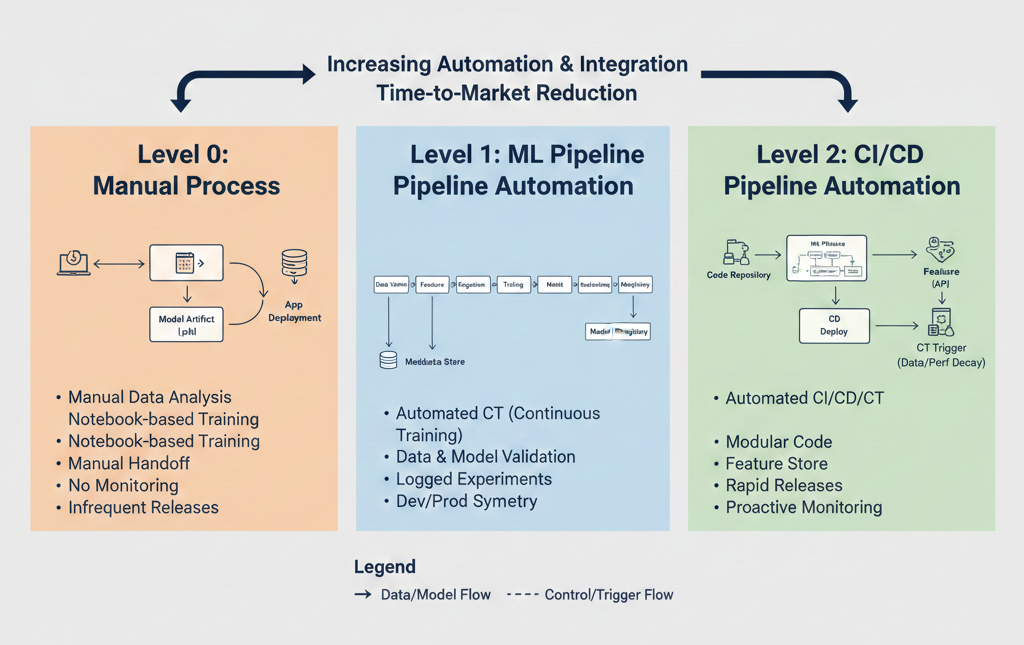
    Diagram: MLOps Maturity Levels Progression. A block diagram illustrating the progression from Level 0 (Manual) to Level 1 (ML Pipeline Automation) and Level 2 (CI/CD Pipeline Automation). Each level highlights increasing degrees of automation and integration.

    4. Key Components of an MLOps Architecture

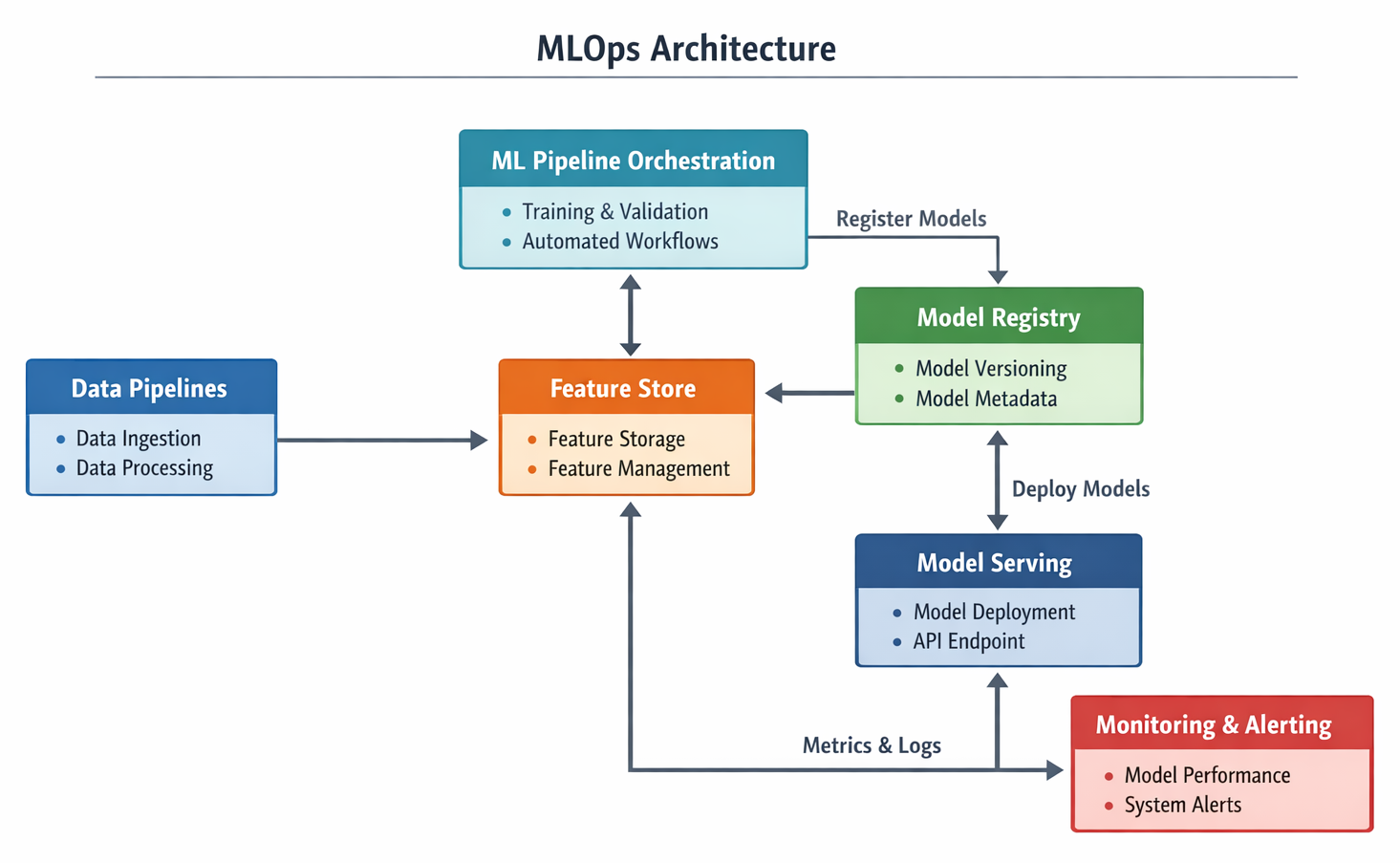
    A robust MLOps architecture brings together various specialized components that work in harmony to manage the entire machine learning lifecycle. Think of these as the building blocks that enable automation, collaboration, and continuous improvement.

    Data Pipeline & Feature Store

    Lorem Ipsum is simply dummy text of the printing and typesetting industry. Lorem Ipsum has been the industry's standard dummy text ever since the 1500s, when an unknown printer took a galley of type and scrambled it to make a type specimen book.

    A crucial component that often integrates with the data pipeline is the Feature Store.

    • What it is: A centralized repository for standardized, versioned, and reusable features. It typically has both an online part (for real-time inference) and an offline part (for batch training).
    • Why it matters: It ensures consistency between features used during training and those used during inference, preventing "training-serving skew". It also promotes feature reuse across different teams and projects, reducing duplication of effort and errors in feature engineering .

    Model RegistryOnce you've trained a model, you need a place to store, track, and manage it. That's where the Model Registry comes in.

    • What it is: A centralized repository for storing, versioning, and managing different versions of your trained ML models. It acts as a logical container for model files and associated metadata.
    • Why it matters: It facilitates model versioning, allowing you to track changes, manage lifecycle stages (e.g., staging, production, archived), and store metadata like training parameters, dataset versions, and performance metrics. This is crucial for reproducibility, governance, and selecting the best model for deployment .

    ML Pipeline OrchestrationAutomating the entire ML workflow requires a conductor, and that's the role of the ML Pipeline Orchestrator .

    • What it is: A system that manages and triggers the various steps of your ML workflow, from data ingestion and preprocessing to model training, evaluation, and deployment . It can launch pipelines on a schedule, in response to events (like new data), or when monitoring alerts are triggered .
    • Why it matters: It automates repetitive tasks, reduces human error, and ensures that your ML models are continuously trained and deployed efficiently . Tools like Kubeflow Pipelines, AWS SageMaker Pipelines, Google Cloud Vertex AI Pipelines, and Azure ML Pipelines are common orchestrators .

    Model Serving & Inference

    Once a model is trained and validated, it needs to be made available for use by applications and end-users. This is the role of Model Serving .

    • What it is: The process of deploying the trained ML model to a production environment and making it accessible for inference (generating predictions). This often involves creating an API endpoint (e.g., REST or GraphQL) that applications can query.
    • Why it matters: It transforms a static model into a dynamic service that can deliver real-time or batch predictions. It also includes managing the computational resources (CPUs, GPUs) needed for inference and implementing strategies like A/B testing or canary deployments for safe rollouts of new model versions .

    Monitoring & Alerting

    Deploying a model isn't the end; it's just the beginning of its life in production. Monitoring and Alerting are critical for ensuring the model continues to perform as expected .
    • What it is: The continuous tracking of a deployed ML model's performance, behavior, and the quality of the data it receives in production . It includes detecting data drift, concept drift, and performance degradation .
    • Why it matters: Models can degrade over time due to changes in real-world data. Monitoring helps detect these issues proactively, triggering alerts, model rollbacks, or automated retraining processes to maintain model accuracy and relevance .

    Diagram: Conceptual MLOps Architecture with Key Components. A block diagram illustrating the interconnected components of an MLOps architecture, including Data Pipelines, Feature Store, ML Pipeline Orchestration, Model Registry, Model Serving, and Monitoring & Alerting, showing the flow of data and models.

    5. Popular MLOps Tools and Platforms

    The MLOps ecosystem is rich with tools and platforms, ranging from comprehensive cloud-native solutions to flexible open-source frameworks. Choosing the right tools depends on your organization's specific needs, existing infrastructure, and team expertise.

    Cloud-Native Solutions

    Major cloud providers offer integrated MLOps platforms that provide end-to-end capabilities, often with deep integration into their broader cloud ecosystems.

  • Amazon Web Services (AWS) - Amazon SageMaker:
    • Overview: A fully managed service that provides purpose-built tools for every step of the ML lifecycle, from data preparation to model deployment and monitoring . It helps organizations achieve Level 2 MLOps maturity at scale .
    • Key Features:
      • SageMaker Experiments: For tracking artifacts, parameters, metrics, and datasets related to training jobs .
      • SageMaker Pipelines: To automate end-to-end ML workflows, including data processing, training, evaluation, and deployment, triggered by schedules or events .
      • SageMaker Model Registry: For centrally tracking model versions, metadata, and performance baselines, aiding in model selection and governance .
      • SageMaker Model Monitor: For continuous monitoring of deployed models for data and concept drift, and performance degradation, with the ability to trigger retraining .
      • SageMaker Feature Store: For consistent feature management between training and inference.
    • Workflow Example: You can build automated workflows using AWS Step Functions Data Science Python SDK, trigger them with CodePipeline, and use SageMaker for training and hosting. For CI/CD, you can integrate with AWS CodeBuild and CodePipeline, using Amazon ECR for custom ML images and SageMaker Model Registry for version management and automated deployment approvals.
  • Microsoft Azure - Azure Machine Learning:
    • Overview: Azure Machine Learning (Azure ML) provides a comprehensive suite of MLOps capabilities, applying DevOps principles to the ML lifecycle for improved quality, consistency, and faster deployment.
    • Key Features:
      • Reproducible ML Pipelines: Define reusable steps for data prep, training, and scoring .
      • Reusable Software Environments: Track and reproduce pip and conda dependencies for consistent builds.
      • Model Registration, Packaging, and Deployment: Register and version models, package them into Docker images, and deploy them as endpoints (batch or real-time). Supports controlled rollouts like A/B testing.
      • Lineage Data Logging: Track end-to-end audit trails of ML assets for governance.
      • Notifications and Alerts: For ML lifecycle events like experiment completion, model registration, deployment, and data drift detection .
      • Monitoring: Track operational and ML-related issues, compare model inputs, and view alerts on infrastructure .
      • Automated End-to-End Lifecycle: Achieved using Azure ML Pipelines and Azure Pipelines for continuous testing, updating, and rolling out models .
    • Workflow Example: Data scientists can check changes into a Git repository, triggering a training job via Azure Pipelines. If a new model performs better, it's registered with the Azure ML Model Registry and deployed using Azure Pipelines. Azure Functions can monitor data drift alerts and trigger retraining pipelines if thresholds are exceeded.
  • Google Cloud Platform (GCP) - Vertex AI:
    • Overview: Vertex AI is Google Cloud's unified ML platform, integrating all AI capabilities into a single, user-friendly environment to improve the stability and reliability of ML systems .
    • Key Features:
      • Vertex AI Pipelines: Automate, monitor, and govern ML workflows, reducing manual effort and errors .
      • Vertex ML Metadata: Track parameters, artifacts, and metrics for analysis, debugging, and auditing .
      • Vertex AI Experiments: Identify the best model by tracking and analyzing different architectures, hyperparameters, and training environments .
      • Vertex AI Feature Store: Centralized repository for organizing, storing, and serving ML features, promoting reuse and consistency .
      • Vertex AI Model Monitoring: Monitors models for training-serving skew and inference drift, sending alerts to trigger retraining if needed .
      • Vertex AI Model Registry: Evaluate, deploy, and manage models and their versions .
    • Workflow Example: You can use Vertex AI Pipelines to orchestrate data preprocessing (e.g., with Dataflow), model training (e.g., Keras with Vertex AI), and deployment. Continuous training can be triggered via Cloud Functions listening to Pub/Sub topics for new data or drift alerts. Model monitoring is configured to detect skew and drift, providing alerts and feature distributions to inform retraining decisions .
  • Open-Source Tools

    For those seeking more control, flexibility, or on-premises deployments, a robust ecosystem of open-source MLOps tools is available.

  • MLflow:
    • Overview: An open-source platform designed to manage the entire ML lifecycle, offering components for experiment tracking, project packaging, model deployment, and a model registry.
    • Key Features:
      • MLflow Tracking: Log and query parameters, metrics, code versions, and output files for experiments.
      • MLflow Projects: Standardize code execution and environments for reproducible workflows.
      • MLflow Models: Standardize packaging of ML models for deployment across various environments.
      • MLflow Model Registry: Centralized repository for managing model versions, stages (staging, production), and metadata.
    • Use Case: Ideal for experiment management, model versioning, and ensuring reproducibility across different ML frameworks. It integrates well with cloud platforms like Databricks.
  • Kubeflow:
    • Overview: A full-fledged open-source MLOps platform built on Kubernetes, designed to make the orchestration and deployment of ML workflows easier . It provides dedicated services for training, pipeline creation, and Jupyter notebook management .
    • Key Features:
      • Kubeflow Pipelines: Orchestrate and automate ML workflows, ensuring scalability and reproducibility .
      • Kubeflow Trainer: For scalable and distributed model training with various frameworks (PyTorch, TensorFlow, etc.) .
      • KServe (formerly KFServing): For production model serving on Kubernetes, offering high-abstraction interfaces for various ML frameworks .
      • Kubeflow Model Registry: A cloud-native component for indexing and managing models, versions, and ML artifacts metadata .
    • Use Case: Best for organizations that are already heavily invested in Kubernetes or want a cloud-agnostic, open-source solution for their MLOps needs . Arrikto offers an enterprise-grade Kubeflow distribution with tools like MiniKF, Kale, and Rok for simplified pipeline generation, debugging, and data versioning .
  • Data Version Control (DVC):
    • Overview: An open-source tool that brings data and model versioning into Git workflows, designed to manage large datasets efficiently .
    • Key Features:
      • Git-like experience: Tracks data and model files by creating small metadata files (.dvc files) that Git versions, while the actual data is stored externally (e.g., cloud storage) .
      • Reproducibility: Ensures datasets are reproducible and traceable throughout the ML lifecycle .
      • Pipeline Framework: Allows you to define reproducible ML pipelines in dvc.yaml that connect stages like preprocessing and training .
      • Metric Tracking: Can track and compare metrics across experiments .
    • Use Case: Essential for managing large datasets and model artifacts alongside code, ensuring reproducibility and traceability, especially when combined with Git and MLflow .
  • Other notable open-source MLOps tools include Pachyderm (version control for data and ML projects on Docker/Kubernetes), Metaflow (Netflix's platform for building and managing enterprise data science projects), Seldon Core (streamlines ML workflows with logging, metrics, and model serving), and Feast (a feature store) .

    6. Putting It All Together: An MLOps Workflow Example

    Let's walk through a simplified MLOps workflow, from an initial notebook experiment to an automated production system, including how automated retraining might be triggered.

    From Notebook to Production: A Simplified Pipeline

    Many ML projects start in a Jupyter Notebook, where data scientists explore data, experiment with algorithms, and tune hyperparameters. This is great for rapid prototyping, but it's not production-ready.

    1. Notebook Experimentation:

    • What you do: Start in a Jupyter Notebook. Explore your data, try different algorithms (like RandomForestClassifier), and tune hyperparameters. Focus on getting the model to perform well on your test data.
    • Why it matters: Notebooks are fantastic for quick iterations and seeing results on the fly.
    • Example Code Snippet (Conceptual):

    Responsive IDE Code Block
       Python
    # In your Jupyter Notebook (initial exploration)
    import pandas as pd
    from sklearn.model_selection import train_test_split
    from sklearn.ensemble import RandomForestClassifier
    from sklearn.metrics import accuracy_score
    
    # Load your data (e.g., from a CSV)
    data = pd.read_csv("your_dataset.csv")
    X = data.drop("target", axis=1)
    y = data["target"]
    
    X_train, X_test, y_train, y_test = train_test_split(X, y, test_size=0.2, random_state=42)
    
    # Train a simple model
    model = RandomForestClassifier(n_estimators=100, random_state=42)
    model.fit(X_train, y_train)
    
    # Evaluate
    predictions = model.predict(X_test)
    accuracy = accuracy_score(y_test, predictions)
    print(f"Initial Model Accuracy: {accuracy}")
    

    2. Refactor Code for Production:

  • What you do: Take your notebook code and refactor it into modular, reusable Python scripts or classes. This makes it easier to maintain and integrate into larger systems.
  • Why it matters: Notebook code can be messy and isn't built for scale. Clean, modular code is essential for production .
  • 3. Set Up Version Control (Code, Data, Models):

  • What you do: Use Git for your code. For large datasets and model artifacts, use tools like DVC (Data Version Control) .
  • Why it matters: Version control ensures reproducibility, tracks changes, and allows you to roll back if needed .
  • Example DVC Workflow (from my_ml_project directory):
  • Responsive IDE Code Block
    Bash
    # Initialize Git and DVC
    git init
    dvc init
    git commit -m "Initialize DVC"
    
    # Add your dataset to DVC (e.g., a 'data' directory)
    dvc add data/
    git add data/.dvc.gitignore
    git commit -m "Add initial dataset with DVC"
    
    # Define your ML pipeline in dvc.yaml
    # This tells DVC how to run your training script and what its dependencies/outputs are
    # dvc.yaml example:
    # stages:
    #   train:
    #     cmd: python train.py
    #     deps:
    #       - data/
    #       - train.py
    #     outs:
    #       - model.joblib
    #     metrics:
    #       - accuracy.json:
    #           cache: false
    
    # Run the DVC pipeline (this will execute train.py)
    dvc repro
    
    # Commit the pipeline definition and model metadata to Git
    git add .
    git commit -m "Add training pipeline and initial model"
    

    This dvc.yaml defines a train stage that runs train.py, depends on data/ and train.py, and outputs model.joblib and accuracy.json .

    4. Automate Data Pipelines:

  • What you do: Build automated workflows for data collection, cleaning, and preparation using orchestrators like Apache Airflow or cloud-native pipeline services.
  • Why it matters: Data changes constantly, and manual processing is a bottleneck. Automation saves time and reduces errors.
  • 5. Track Experiments and Models (e.g., with MLflow):

  • What you do: Use tools like MLflow to log parameters, metrics, and model artifacts for each experiment.
  • Why it matters: This helps you compare different runs, select the best model, and maintain a clear history of your development.
  • Example MLflow Logging in train.py:
  • Responsive IDE Code Block
       Python
    import mlflow
    import mlflow.sklearn
    import joblib
    from sklearn.ensemble import RandomForestClassifier
    from sklearn.model_selection import train_test_split
    from sklearn.metrics import accuracy_score
    import pandas as pd
    
    # Assume data loading and splitting happens here
    data = pd.read_csv("data/your_dataset.csv") # DVC ensures this is the correct version
    X = data.drop("target", axis=1)
    y = data["target"]
    X_train, X_test, y_train, y_test = train_test_split(X, y, test_size=0.2, random_state=42)
    
    with mlflow.start_run():
        # Log hyperparameters
        n_estimators = 100
        mlflow.log_param("n_estimators", n_estimators)
    
        # Train model
        model = RandomForestClassifier(n_estimators=n_estimators, random_state=42)
        model.fit(X_train, y_train)
    
        # Evaluate and log metrics
        predictions = model.predict(X_test)
        accuracy = accuracy_score(y_test, predictions)
        mlflow.log_metric("accuracy", accuracy)
    
        # Save model artifact
        mlflow.sklearn.log_model(model, "random_forest_model")
        joblib.dump(model, "model.joblib") # For DVC tracking
        print(f"Model trained with accuracy: {accuracy}")
    

    6. Containerize Your Application:

  • What you do: Package your model and its dependencies into a Docker container .
  • Why it matters: Containers ensure your application behaves consistently across different environments (local, cloud, etc.), making it portable and scalable .
  • 7. Implement CI/CD:

  • What you do: Set up Continuous Integration (CI) and Continuous Delivery (CD) pipelines using tools like GitHub Actions, GitLab CI, Jenkins, or cloud-native services .
  • Why it matters: Automating testing and deployment speeds up updates and catches issues early, ensuring models are always production-ready .
  • Example CI/CD Pipeline Stages (Conceptual YAML):
  • Responsive IDE Code Block
       YAML
    #.github/workflows/mlops_pipeline.yaml (simplified)
    name: MLOps CI/CD Pipeline
    
    on:
      push:
        branches:
          - main
        paths:
          - 'src/**' # Trigger on code changes
          - 'data/**' # Trigger on data changes (via DVC.dvc files)
    
    jobs:
      # CI Job: Build, Test, Package
      integration:
        runs-on: ubuntu-latest
        steps:
          - name: Checkout Code
            uses: actions/checkout@v3
          - name: Set up Python
            uses: actions/setup-python@v4
            with:
              python-version: '3.9'
          - name: Install Dependencies
            run: pip install -r requirements.txt dvc mlflow scikit-learn pandas
          - name: Pull DVC Data
            run: dvc pull # Ensure correct data version is pulled
          - name: Run Unit Tests
            run: python -m unittest discover tests/unit # Test feature engineering, model logic
          - name: Run Model Training & Log with MLflow
            run: python src/train.py # This script trains model and logs to MLflow
          - name: Evaluate Model Performance
            run: python src/evaluate.py # Script to run performance tests, e.g., accuracy, bias
          - name: Build Docker Image
            run: docker build -t my-ml-model:latest .
          - name: Push Docker Image to Registry
            #... (e.g., to ECR, GCR, Azure Container Registry)
    
      # CD Job: Deploy Model
      deployment:
        needs: integration # Depends on CI job
        runs-on: self-hosted # Or cloud-managed runner
        steps:
          - name: Pull Docker Image
            #... (pull image from registry)
          - name: Deploy Model to Production
            #... (e.g., update Kubernetes deployment, SageMaker endpoint, Vertex AI endpoint)
          - name: Run Post-Deployment Tests (Canary/A/B)
            #... (monitor live traffic, compare performance)
          - name: Register Model in Model Registry
            #... (e.g., MLflow Model Registry, SageMaker Model Registry)
    

    This YAML outlines a basic CI/CD pipeline. The integration job handles code and data validation, model training, and containerization. The deployment job then takes the validated artifacts and deploys them to production .

    Example: Automated Retraining Triggered by Data Drift

    A key advantage of MLOps is the ability to automatically retrain models when their performance degrades in production, often due to data drift.
  • Continuous Monitoring:
    • What happens: Your deployed model is continuously monitored for performance metrics (e.g., accuracy, precision) and data characteristics (e.g., feature distribution changes, outliers) .
    • Drift Detection: Tools like Vertex AI Model Monitoring or SageMaker Model Monitor detect if the incoming inference data deviates significantly from the training data baseline (data drift) or if the relationship between inputs and outputs changes (concept drift) .
  • Triggering Retraining:
    • What happens: If a predefined threshold for performance degradation or data drift is exceeded, an alert is triggered . This alert can then automatically trigger your ML training pipeline .
    • Example Trigger (Conceptual):
      • A monitoring system (e.g., Prometheus + Grafana, or a cloud-native monitoring service) detects that the model's accuracy has dropped by 5% over the last week.
      • An alert is sent to a webhook or a message queue (e.g., AWS SQS, Google Cloud Pub/Sub, Azure Event Grid) .
      • A serverless function (e.g., AWS Lambda, Google Cloud Function, Azure Function) listens for this message .
      • Upon receiving the message, the function triggers the ML pipeline orchestrator (e.g., SageMaker Pipelines, Vertex AI Pipelines, Azure ML Pipelines) to start a new training run .
  • Automated Retraining and Deployment:
    • What happens: The triggered pipeline pulls the latest data, retrains the model, evaluates its performance, and if the new model is better, it's automatically registered and deployed to production, replacing the old one . This entire process is automated, minimizing human intervention .
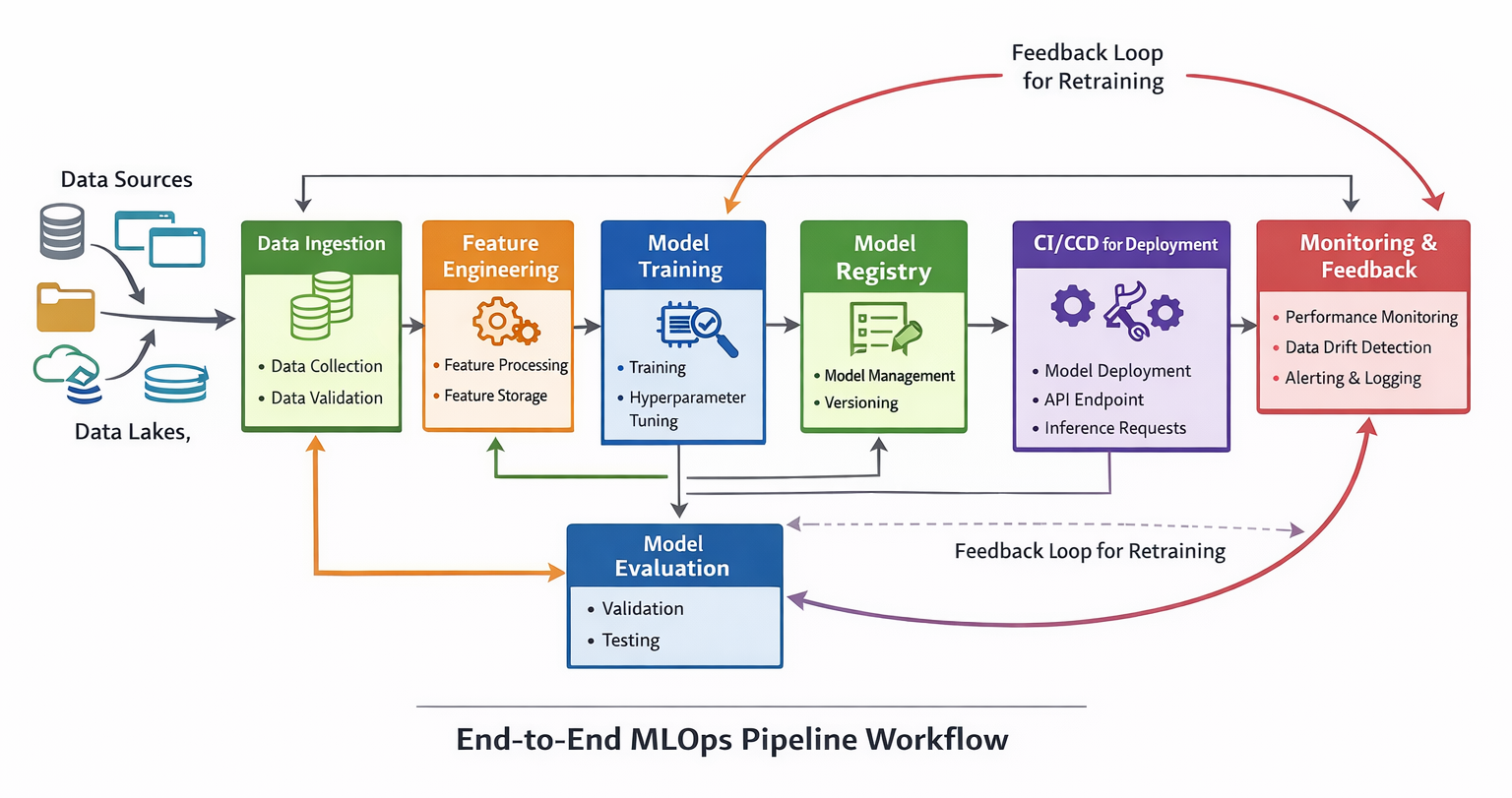
  • Diagram: End-to-End MLOps Pipeline Workflow. A detailed block diagram illustrating the end-to-end MLOps pipeline, starting from data ingestion, through feature engineering, model training, evaluation, model registry, CI/CD for deployment, model serving, and continuous monitoring with a feedback loop triggering retraining.

    7. Conclusion: Your MLOps Journey Starts Now

    We've covered a lot of ground, from the fundamental definition of MLOps and its crucial differences from traditional DevOps, to its core principles, maturity levels, essential architectural components, and popular tools. The takeaway is clear: MLOps is no longer a luxury but a necessity for organizations serious about leveraging machine learning at scale.

    By embracing MLOps, you can:

    • Accelerate Time-to-Market: Get your models from experimentation to production faster.
    • Improve Reliability and Stability: Reduce errors and ensure consistent model performance .
    • Enhance Reproducibility and Traceability: Know exactly how every model was built and why it behaves the way it does .
    • Ensure Continuous Improvement: Keep your models relevant and accurate in a dynamic world through automated retraining and monitoring .
    • Foster Collaboration: Break down silos between data scientists, ML engineers, and operations teams .

    The journey to full MLOps maturity is iterative, but every step you take towards automation, versioning, and continuous practices will bring significant returns on your AI investments.

    Ready to operationalize your machine learning? Start by assessing your current MLOps maturity, then pick one core principle—like versioning your data and models with DVC and MLflow, or setting up a simple CI/CD pipeline for your training code. Experiment with cloud-native services like AWS SageMaker, Azure ML, or Google Cloud Vertex AI to see how they can streamline your workflows. The future of AI is operational, and MLOps is your roadmap to getting there.

    SaratahKumar C

    Founder & CEO, Psitron Technologies
    Launch your GraphyLaunch your Graphy
    100K+ creators trust Graphy to teach online
    𝕏
    Psitron 2026 Privacy policy Terms of use Contact us Refund policy
    Cart ( Items )
    There are no items in your cart
    Add More
    Item Details Price
    You may also be interested in
    Note: Promo Codes can be applied after checkout
    Total Amount $0
    Add More Checkout
    Review